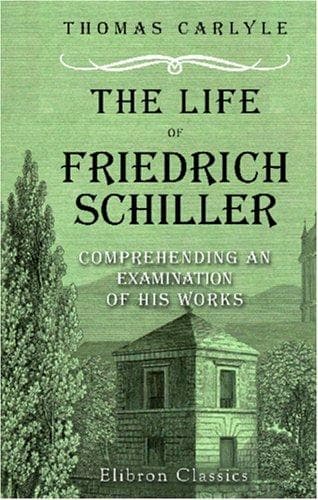
The Life of Friedrich Schiller: Comprehending an Examination of His WorksCarlyle, Thomas
General
The Life of Friedrich Schiller: Comprehending an Examination of His Works
Carlyle, Thomas
Authors, German -- 18th century -- Biography; Schiller, Friedrich, 1759-1805; Schubart, Christian Friedrich Daniel, 1739-1791
Alfieri and Schiller were again unconscious competitors in the history
of Mary Stuart. But the works before us give a truer specimen of their
comparative merits. Schiller seems to have the greater genius; Alfieri
the more commanding character. Alfieri's greatness rests on the stern
concentration of fiery passion, under the dominion of an adamantine
will: this was his own make of mind; and he represents it, with
strokes in themselves devoid of charm, but in their union terrible as
a prophetic scroll. Schiller's moral force is commensurate with his
intellectual gifts, and nothing more. The mind of the one is like the
ocean, beautiful in its strength, smiling in the radiance of summer,
and washing luxuriant and romantic shores: that of the other is like
some black unfathomable lake placed far amid the melancholy mountains;
bleak, solitary, desolate; but girdled with grim sky-piercing cliffs,
overshadowed with storms, and illuminated only by the red glare of the
lightning. Schiller is magnificent in his expansion, Alfieri is
overpowering in his condensed energy; the first inspires us with
greater admiration, the last with greater awe.
This tragedy of _Carlos_ was received with immediate and universal
approbation. In the closet and on the stage, it excited the warmest
applauses equally among the learned and unlearned. Schiller's
expectations had not been so high: he knew both the excellencies and
the faults of his work; but he had not anticipated that the former
would be recognised so instantaneously. The pleasure of this new
celebrity came upon him, therefore, heightened by surprise. Had
dramatic eminence been his sole object, he might now have slackened
his exertions; the public had already ranked him as the first of their
writers in that favourite department. But this limited ambition was
not his moving principle; nor was his mind of that sort for which rest
is provided in this world. The primary disposition of his nature urged
him to perpetual toil: the great aim of his life, the unfolding of his
mental powers, was one of those which admit but a relative not an
absolute progress. New ideas of perfection arise as the former have
been reached; the student is always attaining, never has attained.
Public-domain text, read in full here on John Shaqi.
Reviews
Reviews
No reviews yet
Be the first to share your thoughts on this work.
Elsewhere in the archive
Join the Discussion
Join the discussion
Sign in to leave a comment or review.
Sign InorCreate an account