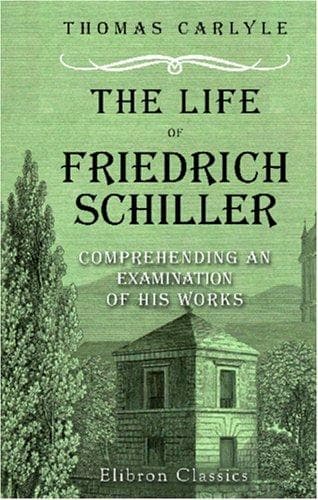
The Life of Friedrich Schiller: Comprehending an Examination of His WorksCarlyle, Thomas
General
The Life of Friedrich Schiller: Comprehending an Examination of His Works
Carlyle, Thomas
Authors, German -- 18th century -- Biography; Schiller, Friedrich, 1759-1805; Schubart, Christian Friedrich Daniel, 1739-1791
all the influence within his power, he succeeded in effecting this;
and what was still more difficult, in suffering the character of
benefactor to merge in that of equal. They became not friends only,
but fellow-labourers: a connection productive of important
consequences in the history of both, particularly of the younger and
more undirected of the two.
Meanwhile the _History of the Revolt of the United Netherlands_ was in
part before the world; the first volume came out in 1788. Schiller's
former writings had given proofs of powers so great and various, such
an extent of general intellectual strength, and so deep an
acquaintance, both practical and scientific, with the art of
composition, that in a subject like history, no ordinary work was to
be looked for from his hands. With diligence in accumulating
materials, and patient care in elaborating them, he could scarcely
fail to attain distinguished excellence. The present volume was well
calculated to fulfil such expectations. The _Revolt of the
Netherlands_ possesses all the common requisites of a good history,
and many which are in some degree peculiar to itself. The information
it conveys is minute and copious; we have all the circumstances of the
case, remote and near, set distinctly before us. Yet, such is the
skill of the arrangement, these are at once briefly and impressively
presented. The work is not stretched out into a continuous narrative;
but gathered up into masses, which are successively exhibited to view,
the minor facts being grouped around some leading one, to which, as
to the central object, our attention is chiefly directed. This method
of combining the details of events, of proceeding as it were, _per
saltum_, from eminence to eminence, and thence surveying the
surrounding scene, is undoubtedly the most philosophical of any: but
few men are equal to the task of effecting it rightly. It must be
executed by a mind able to look on all its facts at once; to
disentangle their perplexities, referring each to its proper head; and
to choose, often with extreme address, the station from which the
reader is to view them. Without this, or with this inadequately done,
a work on such a plan would be intolerable. Schiller has accomplished
it in great perfection; the whole scene of affairs was evidently clear
before his own eye, and he did not want expertness to discriminate and
seize its distinctive features. The bond of cause and consequence he
never loses sight of; and over each successive portion of his
narrative he pours that flood of intellectual and imaginative
brilliancy, which all his prior writings had displayed. His
reflections, expressed or implied, are the fruit of strong,
comprehensive, penetrating thought. His descriptions are vivid; his
characters are studied with a keen sagacity, and set before us in
their most striking points of view; those of Egmont and Orange occur
to every reader as a rare union of perspicacity and eloquence. The
Public-domain text, read in full here on John Shaqi.
Reviews
Reviews
No reviews yet
Be the first to share your thoughts on this work.
Elsewhere in the archive
Join the Discussion
Join the discussion
Sign in to leave a comment or review.
Sign InorCreate an account