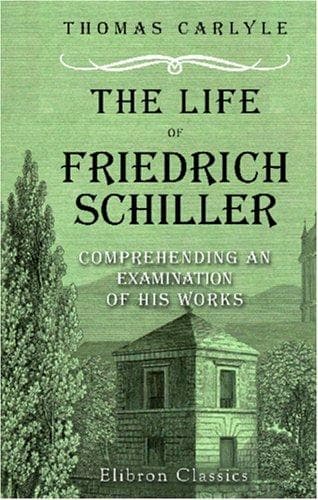
The Life of Friedrich Schiller: Comprehending an Examination of His WorksCarlyle, Thomas
General
The Life of Friedrich Schiller: Comprehending an Examination of His Works
Carlyle, Thomas
Authors, German -- 18th century -- Biography; Schiller, Friedrich, 1759-1805; Schubart, Christian Friedrich Daniel, 1739-1791
This too Schiller was aware of, and had in part attended to. Besides,
the Thirty-Years War is a subject in which nationality of feeling may
be even wholly spared, better than in almost any other. It is not a
German but a European subject; it forms the concluding portion of the
Reformation, and this is an event belonging not to any country in
particular, but to the human race. Yet, if we mistake not, this
over-tendency to generalisation, both in thought and sentiment, has
rather hurt the present work. The philosophy, with which it is embued,
now and then grows vague from its abstractness, ineffectual from its
refinement: the enthusiasm which pervades it, elevated, strong,
enlightened, would have told better on our hearts, had it been
confined within a narrower space, and directed to a more specific
class of objects. In his extreme attention to the philosophical
aspects of the period, Schiller has neglected to take advantage of
many interesting circumstances, which it offered under other points of
view. The Thirty-Years War abounds with what may be called
picturesqueness in its events, and still more in the condition of the
people who carried it on. Harte's _History of Gustavus_, a wilderness
which mere human patience seems unable to explore, is yet enlivened
here and there with a cheerful spot, when he tells us of some scalade
or camisado, or speculates on troopers rendered bullet-proof by
art-magic. His chaotic records have, in fact, afforded to our Novelist
the raw materials of Dugald Dalgetty, a cavalier of the most singular
equipment, of character and manners which, for many reasons, merit
study and description. To much of this, though, as he afterwards
proved, it was well known to him, Schiller paid comparatively small
attention; his work has lost in liveliness by the omission, more than
it has gained in dignity or instructiveness.
Public-domain text, read in full here on John Shaqi.
Reviews
Reviews
No reviews yet
Be the first to share your thoughts on this work.
Elsewhere in the archive
Join the Discussion
Join the discussion
Sign in to leave a comment or review.
Sign InorCreate an account