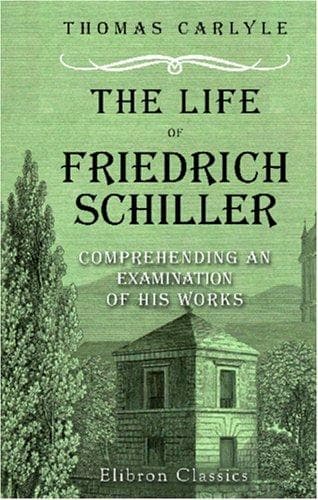
The Life of Friedrich Schiller: Comprehending an Examination of His WorksCarlyle, Thomas
General
The Life of Friedrich Schiller: Comprehending an Examination of His Works
Carlyle, Thomas
Authors, German -- 18th century -- Biography; Schiller, Friedrich, 1759-1805; Schubart, Christian Friedrich Daniel, 1739-1791
Yet, with all its imperfections, this is no ordinary history. The
speculation, it is true, is not always of the kind we wish; it
excludes more moving or enlivening topics, and sometimes savours of
the inexperienced theorist who had passed his days remote from
practical statesmen; the subject has not sufficient unity; in spite of
every effort, it breaks into fragments towards the conclusion: but
still there is an energy, a vigorous beauty in the work, which far
more than redeems its failings. Great thoughts at every turn arrest
our attention, and make us pause to confirm or contradict them; happy
metaphors,[22] some vivid descriptions of events and men, remind us of
the author of _Fiesco_ and _Don Carlos_. The characters of Gustavus
and Wallenstein are finely developed in the course of the narrative.
Tilly's passage of the Lech, the battles of Leipzig and Lützen figure
in our recollection, as if our eyes had witnessed them: the death of
Gustavus is described in terms which might draw 'iron tears' from the
eyes of veterans.[23] If Schiller had inclined to dwell upon the mere
visual or imaginative department of his subject, no man could have
painted it more graphically, or better called forth our emotions,
sympathetic or romantic. But this, we have seen, was not by any means
his leading aim.
[Footnote 22: Yet we scarcely meet with one so happy as that
in the _Revolt of the Netherlands_, where he finishes his
picture of the gloomy silence and dismay that reigned in
Brussels on the first entrance of Alba, by this striking
simile: 'Now that the City had received the Spanish General
within its walls, it had the air as of a man that has drunk a
cup of poison, and with shuddering expectation watches, every
moment, for its deadly agency.']
[Footnote 23: See Appendix I., No. 4.]
On the whole, the present work is still the best historical
performance which Germany can boast of. Müller's histories are
distinguished by merits of another sort; by condensing, in a given
space, and frequently in lucid order, a quantity of information,
copious and authentic beyond example: but as intellectual productions,
they cannot rank with Schiller's. Woltmann of Berlin has added to the
_Thirty-Years War_ another work of equal size, by way of continuation,
entitled _History of the Peace of Munster_; with the first
negotiations of which treaty the former concludes. Woltmann is a
person of ability; but we dare not say of him, what Wieland said of
Schiller, that by his first historical attempt he 'has discovered a
decided capability of rising to a level with Hume, Robertson and
Gibbon.' He will rather rise to a level with Belsham or Smollett.
Public-domain text, read in full here on John Shaqi.
Reviews
Reviews
No reviews yet
Be the first to share your thoughts on this work.
Elsewhere in the archive
Join the Discussion
Join the discussion
Sign in to leave a comment or review.
Sign InorCreate an account