Transcriber's Note.
Variable spelling and hyphenation have been retained. Minor punctuation
inconsistencies have been silently repaired. The author's corrections,
additions and comments have been applied in the text. Changes made by
the transcriber can be found at the end of the book. The original text
is printed in a two-column layout. Formatting and special characters are
indicated as follows:
_italic_
[Illustration: Galileo Galilei]
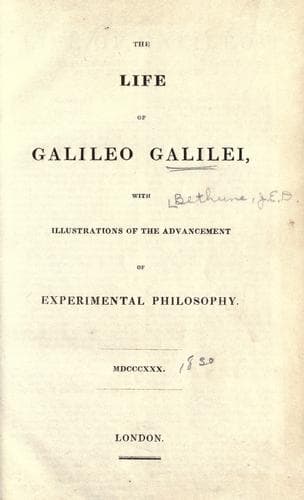
THE
LIFE
OF
GALILEO GALILEI,
WITH
ILLUSTRATIONS OF THE ADVANCEMENT
OF
EXPERIMENTAL PHILOSOPHY.
MDCCCXXX.
LONDON.
LIFE OF GALILEO:
WITH ILLUSTRATIONS OF THE ADVANCEMENT OF EXPERIMENTAL PHILOSOPHY.
CHAPTER I.
_Introduction._
THE knowledge which we at present possess of the phenomena of nature and
of their connection has not by any means been regularly progressive, as
we might have expected, from the time when they first drew the attention
of mankind. Without entering into the question touching the scientific
acquirements of eastern nations at a remote period, it is certain that
some among the early Greeks were in possession of several truths,
however acquired, connected with the economy of the universe, which were
afterwards suffered to fall into neglect and oblivion. But the
philosophers of the old school appear in general to have confined
themselves at the best to observations; very few traces remain of their
having instituted _experiments_, properly so called. This putting of
nature to the torture, as Bacon calls it, has occasioned the principal
part of modern philosophical discoveries. The experimentalist may so
order his examination of nature as to vary at pleasure the circumstances
in which it is made, often to discard accidents which complicate the
general appearances, and at once to bring any theory which he may form
to a decisive test. The province of the mere observer is necessarily
limited: the power of selection among the phenomena to be presented is
in great measure denied to him, and he may consider himself fortunate if
they are such as to lead him readily to a knowledge of the laws which
they follow.
Public-domain text, read in full here on John Shaqi.
Reviews
Reviews
No reviews yet
Be the first to share your thoughts on this work.
Join the Discussion
Join the discussion
Sign in to leave a comment or review.
Sign InorCreate an account