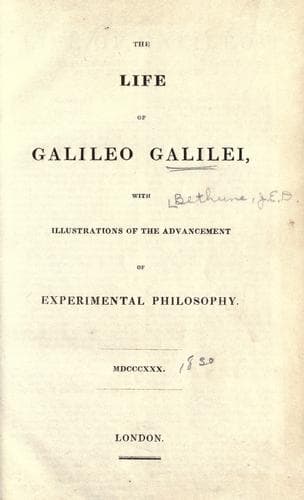
The earliest biographical notice of Galileo is that in the Obituary of
the Mercurio Italico, published at Venice in 1647, by Vittorio Siri. It
is very short, but contains an exact enumeration of his principal works
and discoveries. Rossi, who wrote under the name of Janus Nicius
Erythræus, introduced an account of Galileo in his Pinacotheca Imaginum
Illustrium, in which the story of his illegitimacy first made its
appearance. In 1664, Salusbury published a life of Galileo in the second
volume of his Mathematical Collections, the greater part of which is a
translation of Galileo's principal works. Almost the whole edition of
the second volume of Salusbury's book was burnt in the great fire of
London. Chauffepié says that only one copy is known to be extant in
England: this is now in the well-known library of the Earl of
Macclesfield, to whose kindness the author is much indebted for the use
he has been allowed to make of this unique volume. A fragment of this
second volume is in the Bodleian Library at Oxford. The translations in
the preceding pages are mostly founded upon Salusbury's version.
Salusbury's account, although that of an enthusiastic admirer of
Galileo, is too prolix to be interesting: the general style of the
performance may be guessed from the title of the first chapter—'Of Man
in general, and how he excelleth all the other Animals.' After informing
his readers that Galileo was born at Pisa, he proceeds:—"Italy is
affirmed to have been the first that peopled the world after the
universal deluge, being governed by Janus, Cameses, and Saturn, &c." His
description of Galileo's childhood is somewhat quaint. "Before others
had left making of dirt pyes, he was framing of diagrams; and whilst
others were whipping of toppes, he was considering the cause of their
motion." It is on the whole tolerably correct, especially if we take
into account that Salusbury had not yet seen Viviani's Life, though
composed some years earlier.
The Life of Galileo by Viviani was first written as an outline of an
intended larger work, but this latter was never completed. This sketch
was published in the Memoirs of the Florentine Academy, of which Galileo
had been one of the annual presidents, and afterwards prefixed to the
complete editions of Galileo's works; it is written in a very agreeable
and flowing style, and has been the groundwork of most subsequent
accounts. Another original memoir by Niccolò Gherardini, was published
by Tozzetti. A great number of references to authors who have treated of
Galileo is given by Sach in his Onomasticon. An approved Latin memoir by
Brenna is in the first volume of Fabroni's Vitæ Italorum Illustrium; he
has however fallen into several errors: this same work contains the
lives of several of his principal followers.
The article in Chauffepié's Continuation of Bayle's Dictionary does not
contain anything which is not in the earlier accounts.
Public-domain text, read in full here on John Shaqi.
Reviews
Reviews
No reviews yet
Be the first to share your thoughts on this work.
Elsewhere in the archive
Join the Discussion
Join the discussion
Sign in to leave a comment or review.
Sign InorCreate an account