The loss of Galileo's Essay on Continuous Quantity is particularly to be
regretted, as it would be highly interesting to see how far he succeeded
in methodizing his thoughts on this important topic. It is to his pupil
Cavalieri (who refused to publish his book so long as he hoped to see
Galileo's printed) that we owe "The Method of Indivisibles," which is
universally recognized as one of the first germs of the powerful methods
of modern analysis. Throughout Galileo's works we find many indications
of his having thought much on the subject, but his remarks are vague,
and bear little, if at all, on the application of the method. To this
the chief part of Cavalieri's book is devoted, though he was not so
entirely regardless of the principles on which his method of measuring
spaces is founded, as he is sometimes represented. This method consisted
in considering lines as made up of an infinite number of points,
surfaces in like manner as composed of lines, and solids of surfaces;
but there is an observation at the beginning of the 7th book, which
shews clearly that Cavalieri had taken a much more profound view of the
subject than is implied in this superficial exposition, and had
approached very closely to the apparently more exact theories of his
successors. Anticipating the objections to his hypothesis, he argues,
that "there is no necessity to suppose the continuous quantities made up
of these indivisible parts, _but only that they will observe the same
ratios as those parts do_." It ought not to be omitted, that Kepler also
had given an impulse to Cavalieri in his "New method of Gauging," which
is the earliest work with which we are acquainted, where principles of
this sort are employed.[31]
FOOTNOTES:
[26] Vitæ Italorum Illustrium.
[27] Almagestum Novum, vol. i.
[28] Math. Coll. vol. ii.
[29] Constructio Circini Proportionum. Moguntiæ, 1605.
[30] Treatise of the Nature of Bodies. London, 1665.
[31] Nova Stereometria Doliorum—Lincii, 1615.
CHAPTER VI.
_Invention of the telescope—Fracastoro—Porta—Reflecting
telescope—Roger Bacon—Digges—De
Dominis—Jansen—Lipperhey—Galileo constructs
telescopes—Microscopes—Re-elected Professor at Padua for life._
Public-domain text, read in full here on John Shaqi.
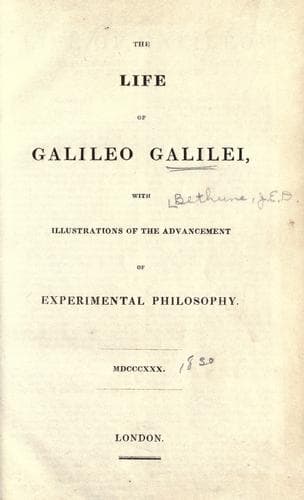
The Life of Galileo Galilei, with Illustrations of the Advancement of Experimental Philosophy: Life of Kepler — John Shaqi
Reviews
Reviews
No reviews yet
Be the first to share your thoughts on this work.
Join the Discussion
Join the discussion
Sign in to leave a comment or review.
Sign InorCreate an account