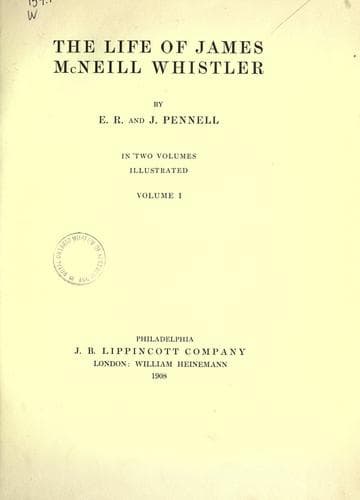
The Life of James McNeill WhistlerPennell, Elizabeth Robins
General
The Life of James McNeill Whistler
Pennell, Elizabeth Robins
Whistler, James McNeill, 1834-1903
The American Whistlers are descended from John Whistler of the Irish
branch. In his youth he ran away and enlisted. Sir Kensington Whistler,
an English cousin, was an officer in the same regiment, and objected
to having a relative in the ranks. John Whistler, therefore, was
transferred to another regiment starting for the American colonies.
He arrived in time to surrender at Saratoga with Burgoyne. He went
back to England, received his discharge, eloped with Anna, daughter
of Sir Edward Bishop or Bischopp, and, returning to America, settled
at Hagerstown, Maryland. He again enlisted, this time in the United
States army. He rose to the brevet rank of major and served in the
war of 1812 against Great Britain. He was stationed at Fort Dearborn,
which he helped to build, and Fort Wayne. According to Mr. A. J. Eddy
(_Recollections and Impressions of Whistler_), Whistler once said to a
visitor from Chicago:
"Chicago, dear me, what a wonderful place! I really ought to visit it
some day; for, you know, my grandfather founded the city, and my uncle
was the last commander of Fort Dearborn!"
In 1815, upon the reduction of the army, Major John Whistler was
retired. He died in 1817, at Bellefontaine, Missouri. Of his fifteen
children, three sons are remembered as soldiers, and three daughters
married army officers. George Washington, the most distinguished son,
was the father of James Abbott McNeill Whistler.
George Washington Whistler was born on May 19, 1800, at Fort Wayne.
He was educated mostly at Newport, Kentucky; and from Kentucky, when
a little over fourteen, he received his appointment to the Military
Academy, West Point, where he is remembered for his gaiety. Mr. George
L. Vose, his biographer, and others tell stories that might have been
told of his son. One is of some breach of discipline, for which he was
made to bestride a gun on the campus. As he sat there he saw, coming
towards him, the Miss Swift he was before long to marry. Out came his
handkerchief, and, leaning over the gun, he set to work cleaning it
so carefully that he was "honoured, not disgraced," in her eyes. He
was number one in drawing, and his playing on the flute won him the
nickname "Pipes." He graduated on July 1, 1819. He was appointed second
lieutenant in the First Artillery, and, in 1829, first lieutenant
in the Second Artillery. He served on topographical duty, and for a
few months he was assistant professor at the Academy. There was not
much fighting for American officers of his generation. But railroads
were being built, and so few were the civil engineers that West Point
graduates were allowed by Government to work for private corporations,
and he was employed on the Baltimore and Ohio Railroad, the Baltimore
and Susquehanna, and the Paterson and Hudson River. For the Baltimore
and Ohio he went to England in 1828 to examine the railway system. He
was building the line from Stonington to Providence, when, in 1833,
Public-domain text, read in full here on John Shaqi.
Reviews
Reviews
No reviews yet
Be the first to share your thoughts on this work.
Join the Discussion
Join the discussion
Sign in to leave a comment or review.
Sign InorCreate an account