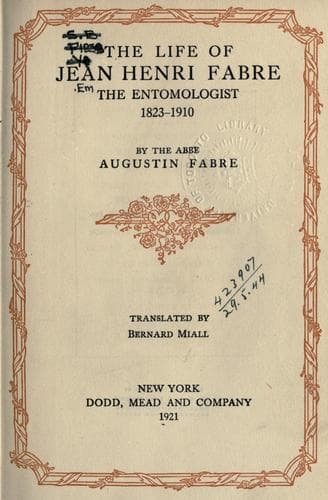
The life of Jean Henri Fabre, the entomologist, 1823-1910Fabre, Augustin
Science
The life of Jean Henri Fabre, the entomologist, 1823-1910
Fabre, Augustin
Entomologists -- France -- Biography; Fabre, Jean-Henri, 1823-1915
But he could not have had the illusion that in thus taking refuge from
the tribulations of which the world is the source, he was placing
himself beyond the reach of any trials. Is it not written that the life
of man upon earth is a perpetual struggle against suffering? And if it
were not for the cruel wounds which it inflicts upon the poor human
heart, we ought rather perhaps to bless this law of our destiny; for it
is one of the qualities of human greatness, of the beauty of the soul
as of the power of the intellect, that it does not fully reveal itself
save under the discipline and empire of suffering.
Among the moral qualities of Fabre as we have been able to divine them
there is one which the vicissitudes of life revealed more especially
during this phase of his existence: I mean his kindliness.
Fabre had the simplicity of the kindly man as well as that of the
truthful man. He, who instinctively withdrew from the gaze and the
malice of men, cared nothing for their smiles or their disdain when
there was a question of adding to his store of scientific data or
kindly actions, however trivial the matter might be.
The following episode is illuminating. Our entomologist was interested,
as a scientist, in discovering whether the bite of the Black-bellied
Tarantula, deadly to insects, was dangerous to other animals, and to
man, or whether it was not, in the latter case, a negligible accident.
He therefore experimented upon a bird:
I make a Tarantula bite the leg of a young, well-fledged Sparrow,
ready to leave the nest. A drop of blood flows: the wounded spot is
surrounded by a reddish circle, changing to purple. The bird almost
immediately loses the use of its leg, which drags, with the toes
doubled in; it hops upon the other. Apart from this, the patient
does not seem to trouble much about his hurt; his appetite is good.
My daughters feed him on flies, bread-crumb, apricot-pulp. He is
sure to get well, he will recover his strength; the poor victim of
the curiosity of science will be restored to liberty. This is the
wish, the intention of us all. Twelve hours later, the hope of a
cure increases; the invalid takes nourishment readily; he clamours
for it, if we keep him waiting. But the leg still drags. I set this
down to a temporary paralysis which will soon disappear. Two days
after, he refuses his food. Wrapping himself in his stoicism and
his rumpled feathers, the Sparrow hunches into a ball, now
motionless, now twitching. My girls take him in the hollow of their
hands and warm him with their breath. The spasms become more
frequent. A gasp proclaims that all is over. The bird is dead.
Public-domain text, read in full here on John Shaqi.
Reviews
Reviews
No reviews yet
Be the first to share your thoughts on this work.
Elsewhere in the archive
Join the Discussion
Join the discussion
Sign in to leave a comment or review.
Sign InorCreate an account