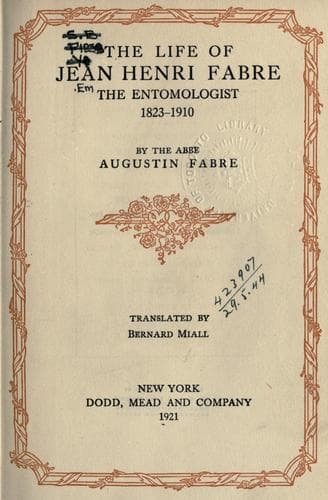
The life of Jean Henri Fabre, the entomologist, 1823-1910Fabre, Augustin
Science
The life of Jean Henri Fabre, the entomologist, 1823-1910
Fabre, Augustin
Entomologists -- France -- Biography; Fabre, Jean-Henri, 1823-1915
So it was, in reality, advantageous, as regards his destiny, that Fabre
suffered, at this juncture of his history, this accumulation of trials,
so grievous to experience, yet so fortunate in their consequences that
they remind us of the sublime passage of the Gospel, whose sayings
regarding eternal life are often rich in lessons for this our present
life: “He that loses his life shall save it.”
(End of the first volume in the French edition.)
CHAPTER XIII
RETIREMENT: ORANGE
It is commonly enough thought that a professor on his vacations and a
pensioned official are very much the same—that both art created and put
into the world merely to kill time and savour the delights of far
niente. Such was never Fabre’s opinion. While he loved nothing so well
as his Thursdays and vacations, this was because he then had more
freedom to devote himself to his favourite studies. If he resigned
himself readily to a premature retirement, if he was even happy to
shake off the yoke of the lycée, this was because he had quite
definitely determined to work more quietly and continuously; because he
hoped to increase the ardour and fertility of his mind by a closer and
more lasting intercourse with the world of Nature.
At the same time he found himself compelled to look to his pen for that
assurance of material life which his retorts had refused him, and which
his meagre professor’s pension afforded but insufficiently. “What is to
be done now?” he cried, after the collapse of his industrial hopes and
professorial ambitions. “Let us try another lever and resume rolling
the Sisyphean stone. Let us seek to draw from the ink-pot what the
madder-vat and the Alma Mater refuses us. Laboremus!”
Laboremus! That indeed is the fitting motto for this period of his
life, no less than for the earlier part of it. For it was then that he
wrote the greater number of his numerous handbooks, now classic, and it
was then that he began to write and to publish his Souvenirs
entomologiques, without ceasing on that account his great life-work,
the passionate observation of the living world.
Still, it is not so much the man’s work as the man, and not so much the
student as the man himself, that we wish to evoke in this chapter.
To live happily, we must live hidden from sight, far from the troubles
of the world, exercising our minds and cultivating our talents at
leisure. Such evidently was Fabre’s idea from the time of his departure
from Avignon; and it plainly reveals to us one of the salient features
of his moral physiognomy.
Public-domain text, read in full here on John Shaqi.
Reviews
Reviews
No reviews yet
Be the first to share your thoughts on this work.
Elsewhere in the archive
Join the Discussion
Join the discussion
Sign in to leave a comment or review.
Sign InorCreate an account