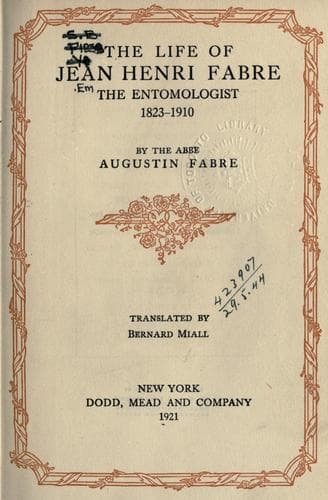
The life of Jean Henri Fabre, the entomologist, 1823-1910Fabre, Augustin
Science
The life of Jean Henri Fabre, the entomologist, 1823-1910
Fabre, Augustin
Entomologists -- France -- Biography; Fabre, Jean-Henri, 1823-1915
There I stand one day, a pensive urchin, with my hands behind my back
and my face turned to the sun. The dazzling splendour fascinates me. I
am the Moth attracted by the light of the lamp. With what am I enjoying
the glorious radiance: with my mouth or my eyes? That is the question
put by my budding scientific curiosity. Reader, do not smile! the
future observer is already practising and experimenting. I open my
mouth wide and close my eyes: the glory disappears. I open my eyes and
shut my mouth: the glory reappears. I repeat the performance, with the
same result. The question’s solved: I have learnt by deduction that I
see the sun with my eyes. What a discovery! That evening I told the
whole house all about it. Grandmother smiled fondly at my simplicity:
the others laughed at it. ’Tis the way of the world.
Another find. At nightfall, amidst the neighbouring bushes, a sort of
jingle attracted my attention, sounding very faintly and softly through
the evening silence. Who is making that noise? Is it a little bird
chirping in his nest? We must look into the matter, and that quickly.
True, there is the wolf, who comes out of the woods at this time, so
they tell me. Let’s go all the same, but not too far: just there,
behind that clump of broom. I stand on the look-out for long, but all
in vain. At the faintest sound of movement in the brushwood, the jingle
ceases. I try again next day and the day after. This time my stubborn
watch succeeds. Whoosh! A grab of my hand and I hold the singer. It is
not a bird; it is a kind of Grasshopper whose hind-legs my playfellows
have taught me to relish: a poor recompense for my prolonged ambush.
The best part of the business is not the two haunches with the shrimpy
flavour, but what I have just learnt. I now know, from personal
observation, that the Grasshopper sings. I did not publish my discovery
for fear of the same laughter that greeted my story about the sun.
Oh, what pretty flowers, in a field close to the house! They seem to
smile to me with their great violet eyes. Later on I see, in their
place, bunches of big red cherries. I taste them. They are not nice,
and they have no stones. What can those cherries be? At the end of the
summer, grandfather walks up with a spade and turns my field of
observation topsy-turvy. From under ground there comes, by the
basketful and sackful, a sort of round root. I know that root; it
abounds in the house; time after time I have cooked it in the
peat-stove. It is the potato. Its violet flower and its red fruit are
pigeon-holed in my memory for good and all.
With an ever-watchful eye for animals and plants, the future observer,
the little six-year-old monkey, practised by himself, all unawares. He
went to the flower, he went to the insect, even as the Large White
Butterfly goes to the cabbage, and the Red Admiral to the thistle.
It would be impossible to describe more delightfully the gradual
development of tastes and aptitudes in the dawn of life.
Public-domain text, read in full here on John Shaqi.
Reviews
Reviews
No reviews yet
Be the first to share your thoughts on this work.
Join the Discussion
Join the discussion
Sign in to leave a comment or review.
Sign InorCreate an account