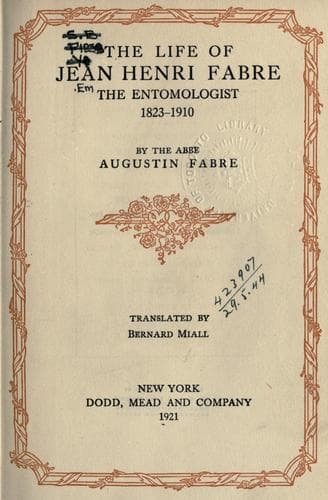
The life of Jean Henri Fabre, the entomologist, 1823-1910Fabre, Augustin
Science
The life of Jean Henri Fabre, the entomologist, 1823-1910
Fabre, Augustin
Entomologists -- France -- Biography; Fabre, Jean-Henri, 1823-1915
How often, at nightfall, by the last glimmers of daylight, have I
not come upon him as I wandered through my garden, hunting for
ideas! Something runs away, rolling over and over in front of me.
Is it a dead leaf blown along by the wind? No, it is the pretty
little Toad disturbed in the midst of his pilgrimage. He hurriedly
takes shelter under a stone, a clod of earth, a tuft of grass,
recovers from his excitement and loses no time in picking up his
liquid note.
On this evening of national merry-making there are nearly a dozen
of him tinkling one against the other around me. Most of them are
squatting among the rows of flower-pots that form a sort of lobby
outside my house. Each has his own note, always the same, lower in
one case, higher in another, a short, clear note, melodious and of
exquisite purity.
With their slow, rhythmical cadence, they seem to be intoning
litanies. Cluck, says one; click, responds another, on a finer
note; clock, adds a third, the tenor of the band. And this is
repeated indefinitely, like the bells of the village pealing on a
holiday: cluck, click, clock! cluck, click, clock!
As a song this litany has neither head nor tail to it; as a
collection of pure sounds, it is delicious. [113]
“A little animated clay, capable of pleasure and pain.” To the scrutiny
of this miracle, with its infinity of forms, Fabre devotes himself with
touching sympathy and indefatigable activity. He dedicates his day to
it; and at night he is still working. And in this work, which seems to
admit of no relaxation, he appears to know nothing of fatigue. The love
of his task upholds him and inspires him. When night has fallen, the
observer has still one resource left; he can listen for the rustle or
the song of the insect that has so far escaped him in its coming and
going. We might, perhaps, have discovered the insect, but he discovers
something very different. He makes a series of observations by the
light of a lantern in the brushwood or before the apparatus in the
harmas.
During the two hottest months, when the darkness is profound and a
little coolness follows the furnace of the day, it is easy for me,
with a lantern in my hand, to watch that magnificent Spider, the
Epeira, in the manufacture of her web. She has established herself
at a height convenient for observation, between a row of
cypress-trees and a thicket of laurels, at the entrance of a path
frequented by nocturnal moths. The situation, it seems, is a good
one, for the Epeira does not change it all the season, although she
renews her net almost every night.
Public-domain text, read in full here on John Shaqi.
Reviews
Reviews
No reviews yet
Be the first to share your thoughts on this work.
Elsewhere in the archive
Join the Discussion
Join the discussion
Sign in to leave a comment or review.
Sign InorCreate an account