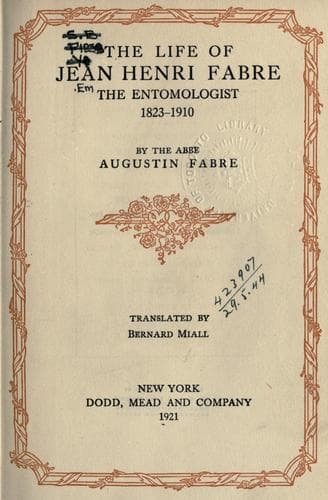
The life of Jean Henri Fabre, the entomologist, 1823-1910Fabre, Augustin
Science
The life of Jean Henri Fabre, the entomologist, 1823-1910
Fabre, Augustin
Entomologists -- France -- Biography; Fabre, Jean-Henri, 1823-1915
Yes, I shall find him; indeed I have him already. A little chap of
seven, with a wide-awake face that doesn’t get washed every day,
bare feet and a pair of tattered breeches held up by a bit of
string, a boy who comes regularly to supply the house with turnips
and tomatoes, arrives one morning carrying his basket of
vegetables. After the few sous due to his mother for the greens
have been counted one by one into his hand, he produces from his
pocket something which he found the day before, beside a hedge,
while picking grass for the rabbits:
“And what about this?” he asks, holding the thing out to me. “What
about this? Will you have it?”
“Yes, certainly, I’ll have it. Try and find me some more, as many
as you can, and I’ll promise you plenty of rides on the roundabout
on Sunday. Meanwhile, my lad, here’s a penny for you. Don’t make a
mistake when you give in your accounts; put it somewhere where you
won’t mix it up with the turnip-money.” [129]
The precious discovery was none other than the cocoon from which would
presently emerge the desired Moth, vainly sought after during twenty
years’ residence in Sérignan.
Of all children Fabre must have had a weakness for the most rustic
specimens; for those who, by virtue of their situation and by
inclination, lived more nearly in contact with Nature and the animal
creation. If they are ever so little wide-awake, they are at once, for
him, friends whose society he seeks and helpers whose assistance he
appreciates. Such is the “young shepherd, a friend of the household,”
who is without a peer in catching the pill-rolling beetles, [130] so
greatly does he excel in profiting by the truly exceptional advantages
which the pastoral calling offers from this point of view.
In such company insect-hunting is so engaging and profitable that our
naturalist decides to accompany him. Among these memorable mornings
there is one which deserves particular mention, for it was truly a
historic occasion:
The young shepherd who had been told in his spare time to watch the
doings of the Sacred Beetle came to me in high spirits, one Sunday
in the latter part of June, to say that he thought the time had
come to begin our investigations. He had detected the insect
issuing from the ground, had dug at the spot where it made its
appearance, and had found, at no great depth, the queer thing which
he was bringing me.
Queer it was, and calculated to upset the little that I thought I
knew. In shape it was exactly like a tiny pear that had lost all
its fresh colour and turned brown in rotting. What could this
curious object be, this pretty plaything that seemed to have come
from a turner’s workshop? Was it made by human hands? Was it a
model of the fruit of the pear-tree intended for some children’s
museum? One would say so.
Public-domain text, read in full here on John Shaqi.
Reviews
Reviews
No reviews yet
Be the first to share your thoughts on this work.
Elsewhere in the archive
Join the Discussion
Join the discussion
Sign in to leave a comment or review.
Sign InorCreate an account