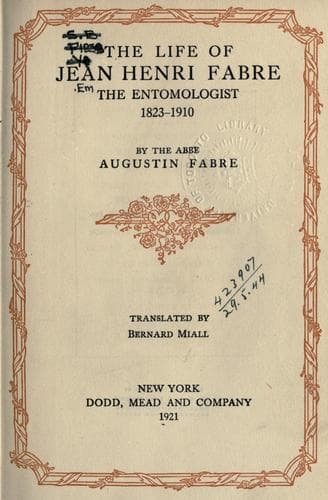
The life of Jean Henri Fabre, the entomologist, 1823-1910Fabre, Augustin
Science
The life of Jean Henri Fabre, the entomologist, 1823-1910
Fabre, Augustin
Entomologists -- France -- Biography; Fabre, Jean-Henri, 1823-1915
The shepherd was at his post by daybreak. I joined him on some
slopes that had been lately cleared of their trees, where the hot
summer sun, which strikes with such force on the back of one’s
neck, could not reach us for two or three hours. In the cool
morning air, with the sheep browsing under Sultan’s care, the two
of us started on our search.
A Sacred Beetle’s burrow is soon found: you can tell it by the
fresh little mound of earth above it. With a vigorous turn of the
wrist, my companion digs away with the little pocket-trowel which I
have lent him. Incorrigible earthscraper that I am, I seldom set
forth without this light but serviceable tool. While he digs I lie
down, the better to see the arrangement and furniture of the cellar
which we are unearthing, and I am all eyes. The shepherd uses the
trowel as a lever and, with his other hand, holds back and pushes
aside the soil.
Here we are! A cave opens out, and, in the moist warmth of the
yawning vault, I see a splendid pear lying full-length upon the
ground. No, I shall not soon forget this first revelation of the
Scarab’s maternal masterpiece. My excitement could have been no
greater had I been an archæologist digging among the ancient relics
of Egypt and lighting upon the sacred insect of the dead, carved in
emerald, in some Pharaonic crypt. O ineffable moment, when truth
suddenly shines forth! What other joys can compare with that holy
rapture! The shepherd was in the seventh heaven; he laughed in
response to my smile and was happy in my gladness. [131]
There was truly good reason for the naturalist and his young friend to
exult. Henri Fabre had just discovered what he had vainly been seeking
for more than thirty years. He now knew the secret of the Sacred
Beetle’s nest; he knew that the loaf of the future nursling was not in
the least like that which the insect rolls along the ground for its own
use. He was now in a position to correct the error of centuries which
he himself had accepted on the word of the masters. And thanks to whom?
Thanks to a shepherd barely “brightened by a little reading” who had
acted as his assistant. The poet was indeed right who said:
“On a souvent besoin d’un plus petit que soi.”
(Of those less than ourselves we oft have need.)
So much the worse for the proud who refuse to realise this! Fabre was
not of their number; and more than once it was greatly to his advantage
that he was not.
In the choice of his collaborators, then, Fabre addressed himself by
preference to children, for he loved their perspicacity, and above all
“the naïve curiosity so like his own.”
But he would also solicit the help of the adult members of his
entourage, if by their situation, their character, their good nature,
or their mental temper he judged them capable of understanding him or,
at all events, of giving him information and assisting him in his
labours.
Public-domain text, read in full here on John Shaqi.
Reviews
Reviews
No reviews yet
Be the first to share your thoughts on this work.
Elsewhere in the archive
Join the Discussion
Join the discussion
Sign in to leave a comment or review.
Sign InorCreate an account