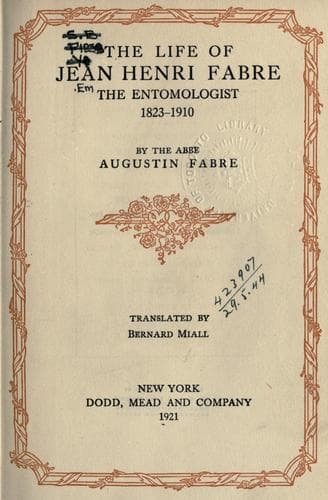
The life of Jean Henri Fabre, the entomologist, 1823-1910Fabre, Augustin
Science
The life of Jean Henri Fabre, the entomologist, 1823-1910
Fabre, Augustin
Entomologists -- France -- Biography; Fabre, Jean-Henri, 1823-1915
The second, Marius Guigne, is a blind man who, a carpenter by
profession, handles his plane and saw in the blackest darkness with
the same sureness of hand as that of a skilful-sighted person in
broad daylight. He lost his sight in his youth, after he had known
the joys of light and the wonders of colour. As a compensation for
perpetual darkness he has acquired a gentle philosophy, always
smiling; an ardent desire to fill, as far as possible, the gaps in
his meagre primary education; a sensitiveness of hearing able to
seize the subtle delicacies of music; and a fineness of touch most
extraordinary in fingers calloused by the labours of the workshop.
During our conversations, if he wishes to be informed as to this or
that geometrical property, he holds out his widely-opened hand.
This is our blackboard. With the tip of my forefinger, I trace on
it the figure to be constructed; accompanying my light touches with
a brief explanation. This is enough; the idea is grasped, and the
saw, plane, and lathe will translate it into reality.
On Sunday afternoons, in winter especially, when three logs flaming
on the hearth form a delicious contrast to the brutalities of the
Mistral, they meet in my house. The three of us form the village
Athenæum, the Rural Institute, where we speak of everything except
hateful politics.... At such a meeting, the delight of my solitude,
to-day’s dinner was devised. The special dish consists of the
cossus, a delicacy of great renown in ancient times.
When he had eaten a sufficient number of nations, the Roman,
brutalised by excess of luxury, began to eat worms. Pliny tells us:
“Romanis in hoc luxuria esse cœpit, prægrandesque roborum vermes
delicatiore sunt in cibo: Cossos vocant.” (The Romans have reached
such a degree of luxury at the table that they esteem as delicious
tit-bits the great worm from the oak-tree known as Cossus.)
I do not know with what sauce the Cossus was eaten in the days of
the Cæsars, the Apicius of the period having left us no information
on this point. Ortolans are roasted on a spit; it would be
profaning them to add the relish of complicated preparation. Let us
proceed in the same manner with the Cossus, these Ortolans of
entomology. Spitted in rows, they are exposed on the grill to the
heat of live embers. A pinch of salt, the necessary condiment of
our dish, is the only addition made to it. The roast grows golden,
softly sizzling, weeps a few oily tears which catch fire on contact
with the coals and burn with a white flame. It is done! Let us
serve it hot.
Public-domain text, read in full here on John Shaqi.
Reviews
Reviews
No reviews yet
Be the first to share your thoughts on this work.
Elsewhere in the archive
Join the Discussion
Join the discussion
Sign in to leave a comment or review.
Sign InorCreate an account