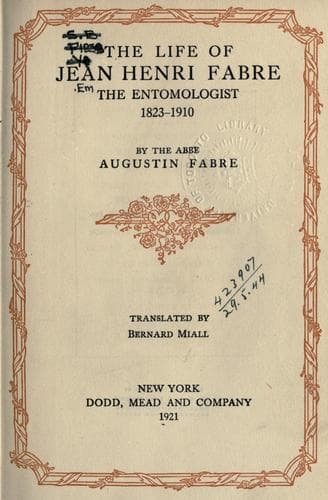
The life of Jean Henri Fabre, the entomologist, 1823-1910Fabre, Augustin
Science
The life of Jean Henri Fabre, the entomologist, 1823-1910
Fabre, Augustin
Entomologists -- France -- Biography; Fabre, Jean-Henri, 1823-1915
Encouraged by my example, my family bravely attack their roast. The
schoolmaster hesitates, the dupe of his imagination, which sees the
great grubs of a little while ago crawling across his plate. He has
taken for himself the smaller specimens, as the recollection of
these disturbs him less. Less subject to imaginary dislikes, the
blind man ruminates and savours them with every sign of
satisfaction.
The testimony is unanimous. The roast is juicy, tender, and
extremely tasty. One recognises in it a certain flavour of burnt
almonds which is enhanced by a vague aroma of vanilla. In short,
the vermicular dish is found to be highly acceptable, one might
even say excellent. What would it be if the refined art of the
gourmets of antiquity had cooked it!...
If I have made this investigation it was certainly not in the hope
of enriching the bill of fare. The rarity of the great grubs and
the repugnance which all kinds of vermin arouses in most of us will
always stand in the way of my discovery becoming a common dish....
As far as I am concerned, it was still less the desire for a dainty
mouthful that actuated me. My sobriety is not easily tempted. A
handful of cherries pleases me better than the preparations of our
kitchens. My only desire was to elucidate a point of natural
history. [134]
I certainly admire this zeal for science and this absence of prejudice
even in the choice of food; yet I am tempted to remark that in the
matter of intrepidity, whether in respect of food or of science, there
is one of Fabre’s circle of acquaintances who surpassed the
schoolmaster and perhaps equals Fabre himself. I am referring to
Favier. Who, then, is Favier?
Favier is an old soldier. He has pitched his hut of clay and
branches under the African carob-trees; he has eaten sea-urchins at
Constantinople; he has shot starlings in the Crimea, during a lull
in the firing. He has seen much and remembered much. In winter,
when work in the fields ends at four o’clock and the evenings are
long, he puts away rake, fork, and barrow, and comes and sits on
the hearth-stone of the kitchen fireplace, where the billets of
ilex-wood blaze merrily. He fetches out his pipe, fills it
methodically with a moistened thumb and smokes it solemnly. He has
been thinking of it for many a long hour; but he has abstained, for
tobacco is expensive. The privation has doubled the charm; and not
one of the puffs recurring at regular intervals is wasted.
Public-domain text, read in full here on John Shaqi.
Reviews
Reviews
No reviews yet
Be the first to share your thoughts on this work.
Elsewhere in the archive
Join the Discussion
Join the discussion
Sign in to leave a comment or review.
Sign InorCreate an account