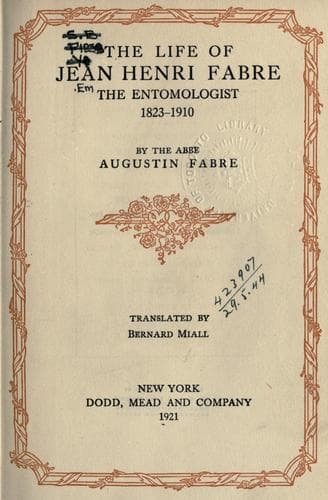
The life of Jean Henri Fabre, the entomologist, 1823-1910Fabre, Augustin
Science
The life of Jean Henri Fabre, the entomologist, 1823-1910
Fabre, Augustin
Entomologists -- France -- Biography; Fabre, Jean-Henri, 1823-1915
Favier knows many things; and he knows them more particularly
through having eaten them. He knows the virtues of a Badger’s back,
the toothsome qualities of the leg of a Fox; he is an expert as to
the best part of that Eel of the bushes, the Snake; he has browned
in oil the Eyed Lizard, the ill-famed Rassade of the South; he has
thought out the recipe of a fry of Locusts. I am astounded at the
impossible stews which he has concocted during his cosmopolitan
career.
I am no less surprised at his penetrating eye and his memory for
things. I have only to describe some plant, which to him is but a
nameless weed, devoid of the least interest; and, if it grows in
our woods, I feel pretty sure that he will bring it to me and tell
me the spot where I can pick it for myself. The botany of the
infinitesimal even does not foil his perspicacity.
But, above all, he excels in ridding me of the troublesome folk
whom I meet upon my rambles. The peasant is naturally curious, as
fond of asking questions as a child; but his curiosity is flavoured
with a spice of malice and in all his questions there is an
undercurrent of chaff. What he fails to understand he turns into
ridicule. And what can be more ludicrous than a gentleman looking
through a glass at a Fly captured with a gauze net, or a bit of
rotten wood picked up from the ground? Favier cuts short the
bantering catechism with a word. [135]
Favier has other qualities: he does not hesitate in the face of
difficulties, and it is a point of honour with him to acquit himself
manfully, however arduous the task.
Favier is not content with faithfully executing his master’s orders.
Like all intelligent and devoted servants, he divines and anticipates
his desires. He has happy ideas of initiative.
On the 14th of April 1880, Favier was clearing away a heap of mould
resulting from the waste weeds and leaves heaped up in a corner
against the enclosing wall.... In the midst of his work with spade
and wheelbarrow, he suddenly called me:
“A find, sir, a splendid find! Come and look!”
I hurried up. There, indeed, was a splendid discovery, and of a
kind to fill me with delight, reawakening all my old memories of
the Bois des Issarts. [136]
There swarmed a whole population of Scarabæi, in the form of larvæ,
nymphs, and adult insects. There, too, were crowds of Rose-beetles
(Cetoniæ), all stages being represented. There, too, were great numbers
of Scoliæ, the Two-striped Scoliæ having recently emerged from their
cocoons, which still had beside them the skins of the game served to
the larvæ; and there, before the naturalist’s eyes, was the solution of
the problem of the Scolia’s food, which “his painful researches in the
Bois des Issarts had not enabled him to solve.” [137] Less than this
had been needed for Favier to merit mention in the order of the day!
Public-domain text, read in full here on John Shaqi.
Reviews
Reviews
No reviews yet
Be the first to share your thoughts on this work.
Elsewhere in the archive
Join the Discussion
Join the discussion
Sign in to leave a comment or review.
Sign InorCreate an account