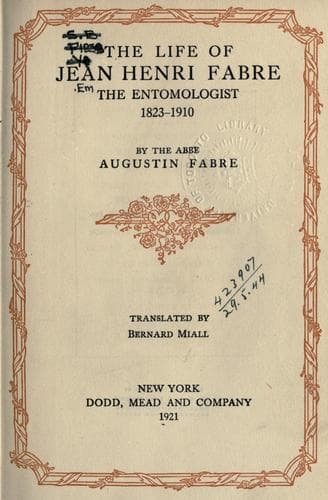
The life of Jean Henri Fabre, the entomologist, 1823-1910Fabre, Augustin
Science
The life of Jean Henri Fabre, the entomologist, 1823-1910
Fabre, Augustin
Entomologists -- France -- Biography; Fabre, Jean-Henri, 1823-1915
At the beginning of this chapter should we not have placed the insects
themselves at the head of Fabre’s collaborators in his researches? When
the insect takes a hand, Favier himself is out of the running.
In the meantime we have no intention of belittling Favier, or of
retracting the praise which has been lavished upon him. Despite his
inevitable deficiencies, and sometimes even because of them, Fabre owes
him much. He owes him important manual services; he owes him curious
data and inestimable discoveries; lastly, he owes him hitherto unknown
opinions relating to evolution, for Favier is an evolutionist, and a
highly original one.
For him the bat is a rat that has grown wings; the cuckoo is a
sparrow-hawk that has retired from business; the slug, a snail
which, through advancing age, has lost its shell; the night-jar,
the etraoucho-grepaou, as he calls it, is an old toad which, having
developed a passion for milk, has grown feathers in order to enter
the folds and milk the goats. It would be impossible to get these
fantastic ideas out of his head. Favier is, as will be seen, an
evolutionist after his fashion, and a daring evolutionist. Nothing
gives him pause in tracing the descent of animals. He has a reply
for everything: this comes from that. If you ask why, he replies:
“See how like they are!”
Shall we reproach him for these insanities when we hear scientists
acclaiming the pithecanthropos as the precursor of man, led astray
as they are by the formation of the monkey? Shall we reject the
metamorphoses of the chavucho-grapaou when there are men who will
seriously tell us that in the present condition of science it is
absolutely proved that man is descended from some vaguely sketched
monkey? Of the two transformations Favier’s seems to me the more
admissible. A painter, a friend of mine, the brother of the great
musician, Félicien David, imparted to me one day his reflections
concerning the human structure. “Vé, moun bel ami,” he said, “vé:
l’homé a lou dintré d’un por et lou déforo d’uno mounino” (Man has
the inside of a pig and the outside of a monkey). I recommend the
painter’s jest to those who wish to derive man from the wild boar,
when the monkey is out of fashion. According to David the descent
is confirmed by internal resemblances: “L’homé a lou dintré d’un
por.”
And, therefore, the naturalist proceeds to make some wise reflections
which we owe in the first place to Favier:
Let us avoid generalisations that are not founded upon sufficiently
numerous and solid foundations. Where these foundations are lacking
the child is the great generaliser.
Public-domain text, read in full here on John Shaqi.
Reviews
Reviews
No reviews yet
Be the first to share your thoughts on this work.
Elsewhere in the archive
Join the Discussion
Join the discussion
Sign in to leave a comment or review.
Sign InorCreate an account