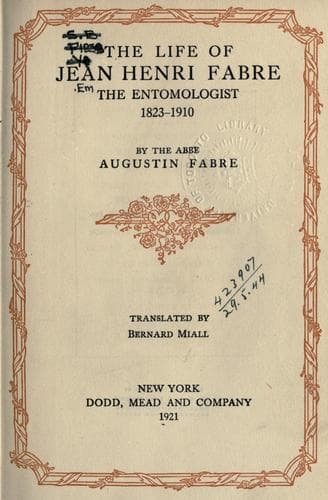
The life of Jean Henri Fabre, the entomologist, 1823-1910Fabre, Augustin
Science
The life of Jean Henri Fabre, the entomologist, 1823-1910
Fabre, Augustin
Entomologists -- France -- Biography; Fabre, Jean-Henri, 1823-1915
On his part the English scientist does full justice to the French
scientist’s incomparable mastery in the study of insects. We have often
mentioned the title of “inimitable observer” which he gives him in his
work on the Origin of Species. In a letter dated the 16th of April
1881, he wrote to Mr. Romanes, who was preparing a book on Animal
Intelligence: “I do not know whether you would care to discuss in your
book some of the more complicated and marvellous instincts. It is an
ungrateful task.... But if you discuss some of these instincts, it
seems to me that you could not take a more interesting point than that
of the animals that paralyse their prey, as Fabre has described in his
astonishing memoir in the Annales des sciences naturelles, a memoir
which he has since amplified in his admirable Souvenirs.”
When he wrote this Darwin was acquainted only with the first volume of
the Souvenirs. [142] What would he have said if he could have enjoyed
the whole of the learned entomologist’s masterly work?
In reading this first volume, the attention of the English naturalist
had been especially struck by the operations of the Hunting Wasps,
which were peculiarly upsetting to his theories.
Darwin was visibly preoccupied by the problem of instinct as propounded
by the irrefutable observations of the French entomologist, but he did
not despair of finding a solution in conformity with his system. Fabre,
on his side, believed that his position was inexpugnable, and was not
without hope of converting Darwin by what appeared to him to be the
evidence of the facts.
Nowhere does the theory of evolution come full tilt against so
immovable an obstacle. Darwin, a true judge, did not fail to
realise this. He greatly dreaded the problem of the instincts. My
first results in particular had left him anxious. If he had known
the tactics of the Hairy Ammophila, the Mantis-hunting Tachytus,
the Philanthus apivorus, the Calicurgus, and other predatory
insects which have since been investigated, his anxiety, I believe,
would have become a frank avowal of his inability to get instinct
to enter the world of his formula. Alas! the philosopher of Down
left us when the discussion was only just beginning, with
experiment to fall back upon, a method superior to all arguments.
The little that I had published at that period left him still some
hope of explanation. In his eyes instinct is always an acquired
habit.
Public-domain text, read in full here on John Shaqi.
Reviews
Reviews
No reviews yet
Be the first to share your thoughts on this work.
Elsewhere in the archive
Join the Discussion
Join the discussion
Sign in to leave a comment or review.
Sign InorCreate an account