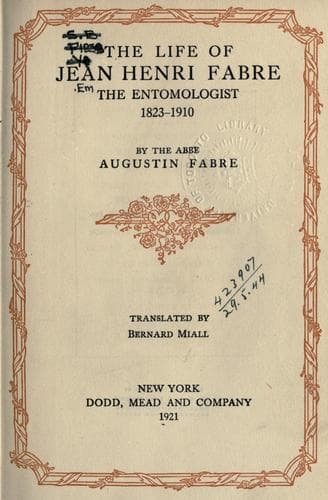
The life of Jean Henri Fabre, the entomologist, 1823-1910Fabre, Augustin
Science
The life of Jean Henri Fabre, the entomologist, 1823-1910
Fabre, Augustin
Entomologists -- France -- Biography; Fabre, Jean-Henri, 1823-1915
For him the feathered race means just the bird, and the reptile
family the snake, without other differences than those of
magnitude. Ignorant of everything, he generalises to the utmost,
simplifying in his inability to see the complex. Later on he will
learn that the Sparrow is not the Bullfinch, that the Linnet is not
the Greenfinch; he will particularise, and he will do so more and
more daily as his faculty of observation is more widely exercised.
At first he saw nothing but resemblances, now he sees differences,
but not yet so clearly as to avoid incongruous comparisons and
zoological solecisms like those which my gardener utters. [138]
This chapter was to have taken the form of a letter addressed to
Charles Darwin, the illustrious naturalist who now lies buried
beside Newton in Westminster Abbey. It was my task to report to him
the result of some experiments which he had suggested to me in the
course of our correspondence: a very pleasant task, for, though
facts, as I see them, disincline me to accept his theories, I have
none the less the deepest veneration for his noble character and
his scientific honesty. I was drafting my letter when the sad news
reached me: Darwin was dead: [139] after searching the mighty
question of origins, he was now grappling with the last and darkest
problem of the hereafter. [140]
This is what we need at the head of the seventh chapter of the second
volume of the Souvenirs. Especially coming after what has gone before
them, these few lines shed a more brilliant light upon Fabre’s secret
attitude toward those very thinkers whose ideas he opposes most keenly
than could any number of lectures. We have here the practical
exemplification of that beautiful profession of faith inspired by Saint
Augustine, which he has recorded elsewhere: “I wage war boldly upon
those ideas that I believe untrue: but God preserve me from ever doing
so upon those who maintain them.” [141]
In his constant skirmishes against the theory of evolution, even in the
set battles which he occasionally fights, whenever he writes Charles
Darwin’s name he mentions it with evident accents of respect and
sympathy, gladly referring to him as “the master,” “the illustrious
master,” “the venerated master.”
Public-domain text, read in full here on John Shaqi.
Reviews
Reviews
No reviews yet
Be the first to share your thoughts on this work.
Elsewhere in the archive
Join the Discussion
Join the discussion
Sign in to leave a comment or review.
Sign InorCreate an account