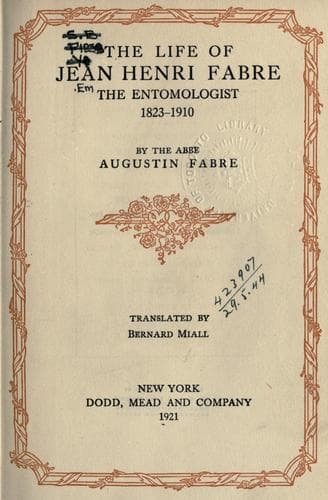
The life of Jean Henri Fabre, the entomologist, 1823-1910Fabre, Augustin
Science
The life of Jean Henri Fabre, the entomologist, 1823-1910
Fabre, Augustin
Entomologists -- France -- Biography; Fabre, Jean-Henri, 1823-1915
“Let us preserve the relic. It was where he toiled so hard to teach
himself and make himself capable of teaching others; it was where
he so long consumed his strength to find food for us when we were
little. Let us keep the sacred plank.”
I dare not believe in such a future for you. You will pass into
strange hands, O my old friend; you will become a bedside-table
laden with bowl after bowl of linseed-tea, until, decrepit,
rickety, and broken-down, you are chopped up to feed the flames for
a brief moment under the simmering saucepan. You will vanish in
smoke to join my labours in that other smoke, oblivion, the
ultimate resting-place of our vain agitations. [145]
The little table protests to-day. It has no desire whatever to go up in
smoke with the labour in which it has borne its part; it flatters
itself, on the contrary, with the hope that having shared in the toil
it may also have some chance of sharing the honour. Rather than this
unjust sentence of death, it seems to hear a summons to life:
“Let us go back, O my table, to the days of our youth, the days of your
French polish and my smiling illusions,” and it stands proudly upon its
legs, as though to serve as a support for these pages destined to
recapitulate Fabre’s written work, all that work which it has helped
him to compose, from the first line to the last.
Of the first literary or scientific exercises of the youthful Fabre and
the first quivers of the little table under the nervous, valiant,
indefatigable pen of the young Carpentras schoolmaster, we shall say
nothing, unless that there was really some excuse for trembling before
the audacious and strenuous toil of the beginning, and all the
exercise-books stuffed with figures and formulæ, diagrams and texts
which represent the solitary and strictly personal work of preparation
for two bachelor’s degrees, quickly followed by those of the licentiate
and the doctor. It was an anatomical work, a memoir on the reproductive
organs of the Myriapods, or Centipedes, that won for Fabre the degree
of Doctor of Science.
Fabre’s first contribution to the Press was a memoir on the Predatory
Hymenoptera, published in the Annales des sciences naturelles. This
attracted great attention among the masters of science. The Institute
of France awarded him a prize for experimental physiology. Darwin, then
at the height of his fame, saluted him with amazed and rather uneasy
admiration. Léon Dufour, the patriarch of entomology in those days,
wrote the author a most eulogistic and encouraging letter; happy to
have directed his researches toward discoveries which he himself had
not suspected, the venerable scientist emphatically exhorted his young
friend to continue his journey along the path that was opening before
him, a path so full of promise.
Public-domain text, read in full here on John Shaqi.
Reviews
Reviews
No reviews yet
Be the first to share your thoughts on this work.
Elsewhere in the archive
Join the Discussion
Join the discussion
Sign in to leave a comment or review.
Sign InorCreate an account