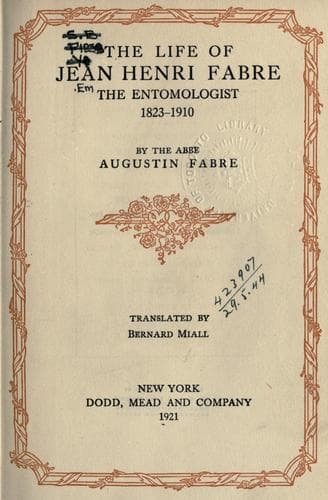
The life of Jean Henri Fabre, the entomologist, 1823-1910Fabre, Augustin
Science
The life of Jean Henri Fabre, the entomologist, 1823-1910
Fabre, Augustin
Entomologists -- France -- Biography; Fabre, Jean-Henri, 1823-1915
Some time after this he published another entomological work which was
by no means calculated to disappoint the hopes aroused by the first. It
dealt with an insect related to the Cantharides, the Sitaris humeralis,
and it contained matter no less unsuspected and no less astonishing
than the first.
The impression produced was all the more profound in that the miracle
of instinct was here accompanied by a physiological miracle, a
phenomenon of metamorphosis wholly unknown, to describe which Fabre hit
upon the very happy term hypermetamorphosis. To the ordinary series of
transformations through which the insect passes in proceeding from the
larval condition to that of the nymph and the perfect insect, this
strange little beast adds another as a prelude to the first, so that
the larva of the Sitaris passes through four different forms, known as
the primary larva, the secondary larva, the pseudo-chrysalis, and the
tertiary larva, and these resemble one another so little that only the
most sustained attention on the observer’s part enables him to believe
the testimony of his eyes.
All these revelations keenly stimulated the curiosity and emulation of
the specialists, and set them “on the track of the history, hitherto
mysterious, of the Cantharides and all the insects resembling them....
A number of naturalists, Beauregard, Riley, Valéry-Mayet, Künckel
d’Herculais, Lichtenstein, and others began to study the insects more
or less adapted to the preparation of blisters: the Mylabres, the
Meloës, the Cantharides. Lichtenstein even carried the larvæ of the
Cantharides in his watch pocket, enclosed in small glass tubes, so that
he could keep them warm and observe them at any moment.”
It was by reading the memoir on the peregrinations and metamorphoses of
the Sitaris that M. Perrier [146] made the acquaintance of Fabre’s
work, of which he was to become one of the most competent judges and
fervent and eloquent admirers. He referred to this essay last year in
his speech at the Sérignan jubilee:
It was in 1868. I had only just left the Higher Normal College, and
was a very youthful assistant naturalist at the Museum. I can still
see myself on the box-seat of an omnibus, crossing the Place de la
Concorde, with an open book on my knees; I was reading the history
of the Sitaris humeralis; I was marvelling at its complicated
metamorphoses and its ruses for making its way into the nest of the
solitary Bee. [147]
These early essays were followed by many others, also published in the
Annales des sciences naturelles, and were always received with the same
favour by all the notable scientists of the time.
Public-domain text, read in full here on John Shaqi.
Reviews
Reviews
No reviews yet
Be the first to share your thoughts on this work.
Elsewhere in the archive
Join the Discussion
Join the discussion
Sign in to leave a comment or review.
Sign InorCreate an account