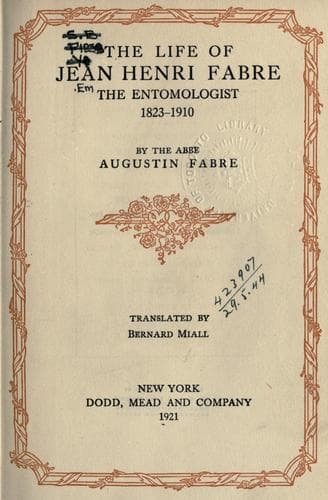
The life of Jean Henri Fabre, the entomologist, 1823-1910Fabre, Augustin
Science
The life of Jean Henri Fabre, the entomologist, 1823-1910
Fabre, Augustin
Entomologists -- France -- Biography; Fabre, Jean-Henri, 1823-1915
By seasoning the matter with indigestible terms, useful for
dissimulating vagueness of thought, one might represent the Cione
as a superb example of the change brought about by the centuries in
the habits of an insect. It would be very scientific, but would it
be very clear? I doubt it. When my eyes fall upon a page bristling
with barbarous locutions, supposedly scientific, I say to myself:
“Take care! The author does not properly understand what he is
saying, or he would have found, in the vocabulary which so many
clever minds have hammered out, some means of clearly stating his
thought.”
Boileau, who is denied the poetic afflatus, but who certainly
possessed common sense, and plenty of it, informs us:
“Ce que l’on conçoit bien s’énonce clairement.”
(That which is clearly grasped is plainly said.)
“Just so, Nicolas! Yes, clearness, always clearness. He calls a cat
a cat. Let us do the same: let us call gibberish a most learned
prose, to afford a pretext for repeating Voltaire’s witty remark:
‘When the listener does not understand and the speaker himself does
not know what he is saying, that is metaphysics.’ Let us add: ‘And
abstruse science.’”
My conviction is that we can say excellent things without using a
barbarous vocabulary. Lucidity is the sovereign politeness of the
writer. I do my best to achieve it. [164]
Thanks to his love of lucidity and simplicity, as much as to his frank
and modest spirit, he had a horror of verbal snobbery and juggling with
pretentious words. Official science itself, and, as he says bluntly,
“official jargon,” [165] find no more favour in his eyes than the sins
of incidental writers.
As a boy [writes Fabre] I was always an ardent reader; but the
refinements of a well-balanced style hardly interested me: I did
not understand them. A good deal later, when close upon fifteen, I
began vaguely to see that words have a physiognomy of their own.
Some pleased me better than others by the distinctness of their
meaning and the resonance of their rhythm; they produced a clearer
image in my mind; after their fashion, they gave me a picture of
the objects described. Coloured by its adjective and vivified by
its verb, the name became a living reality: what it said I saw. And
thus, gradually, was the magic of words revealed to me, when the
chances of my undirected reading placed a few easy standard pages
in my way. [166]
The magic of words! He has done more than discover it in the pages of
other writers. He has illustrated it on every page of his own writings,
adapting it so exactly to the magic of things that it delights the
scientist as Nature herself would, and enchants the poet and the man of
letters as only the masterpieces of art and literature have power to
do.
CHAPTER XX
FABRE’S WRITINGS (CONTINUED)
Public-domain text, read in full here on John Shaqi.
Reviews
Reviews
No reviews yet
Be the first to share your thoughts on this work.
Elsewhere in the archive
Join the Discussion
Join the discussion
Sign in to leave a comment or review.
Sign InorCreate an account