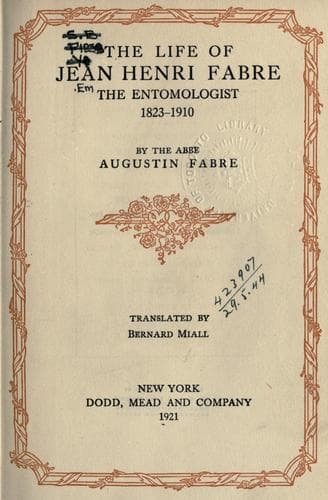
The life of Jean Henri Fabre, the entomologist, 1823-1910Fabre, Augustin
Science
The life of Jean Henri Fabre, the entomologist, 1823-1910
Fabre, Augustin
Entomologists -- France -- Biography; Fabre, Jean-Henri, 1823-1915
But the majority do not watch over the hatching or the growth of their
larvæ. They are forced therefore to lay up a store of food beforehand.
They know this, and are not found wanting. But here they are confronted
by a most difficult problem. If the prey carried to the nest is dead,
it will quickly putrefy; it cannot possibly keep fresh, as it must, for
the weeks and months of the larva’s growth. If it is alive it cannot
easily be seized by the larvæ, and will represent a menace or even a
deadly danger. The Wasp must discover the secret of producing, in her
victims, the immobility of death together with the incorruptibility of
life. And the Wasps have discovered this secret, for the prey which
they provide for their larvæ remain at their disposal to the end
without movement and without deterioration. Do these tiny creatures
know intuitively the secrets of asepsis which Pasteur discovered with
so much difficulty? Such was the conclusion with which Dufour was
forced to content himself. He presumed the existence, in the Hunting
Wasps, of a virus which was at once a weapon of the chase and a liquid
preservative, for the immolation and conservation of the victims. But
even if aseptic a dead insect would shrivel up into a mummy. Now this
must not occur, and as a matter of fact the Wasp’s victims remain moist
indefinitely, just as if alive. And in reality they are not dead; they
are still alive. Fabre has demonstrated this by proving the persistence
of the organic functions, and by feeding some of them by hand. In
short, it is incontestable that the victims are not put to death but
merely deprived of movement, smitten with paralysis. How has this
result, more miraculous even than asepsis, been obtained by the insect?
By the procedure that the most skilful physiologist would employ. By
plunging its sting into the victim’s body, not at random, which might
kill it, but at certain definite points, exactly where the invisible
nervous ganglia are located which control the various movements.
For the rest, the operative method varies according to the species and
anatomy of the victim.
In his investigation of the paralysers, Dufour was unable to imagine
any other weapon of the chase than the mere inoculation of a deadly
virus; the Hymenopteron has invented a means of immobilising her victim
without killing it, of abolishing its movements without destroying its
organic functions, of dissociating the nervous system of the vegetative
life from that of the life of reaction; to spare the first while
annihilating the second, by the precise adaptation of this delicate
surgery to the victim’s anatomy and physiology. Dufour was unable to
provide anything better for the larva’s larder than mummified victims,
shrivelled and more or less flavourless; the Hymenopteron provided them
with living prey, endowed with the strange prerogative of keeping fresh
indefinitely without food and without movement, thanks to paralysis,
far superior in this connection to asepsis.
Public-domain text, read in full here on John Shaqi.
Reviews
Reviews
No reviews yet
Be the first to share your thoughts on this work.
Elsewhere in the archive
Join the Discussion
Join the discussion
Sign in to leave a comment or review.
Sign InorCreate an account