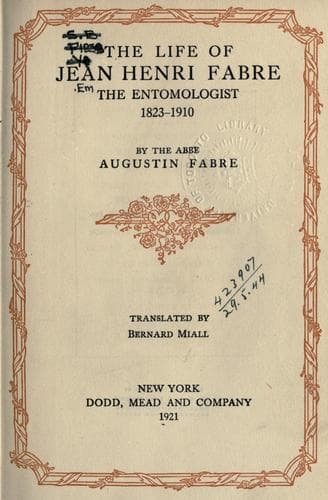
The life of Jean Henri Fabre, the entomologist, 1823-1910Fabre, Augustin
Science
The life of Jean Henri Fabre, the entomologist, 1823-1910
Fabre, Augustin
Entomologists -- France -- Biography; Fabre, Jean-Henri, 1823-1915
“He, the master, skilled among the skilful, trained in the finest
operations of anatomy; he who, with lens and scalpel, had examined the
whole entomological series, leaving not a corner unexplored; he,
finally, who has nothing more to learn of the organisation of the
insect, can think of nothing better than an antiseptic fluid which
gives at least an appearance of an explanation of a fact that leaves
him confounded,” and of which he has not discovered the full miracle.
The author of this immortal discovery rightly insists on “this
comparison between the insect’s instinct and the scientist’s reason,
the better to reveal in its true light the crushing superiority of the
insect.”
As though to give yet another verification of the words so justly
applied to entomology—maxime miranda in minimis—the larva’s science is
perhaps even more disconcerting than that of the perfect insect.
The Scolia’s larva stupefies us by the order in which it proceeds to
devour its victim.
“It proceeds from the less essential to the more essential, in order to
preserve a remnant of life to the very last. In the first place it
absorbs the blood which issues from the wound which it has made in the
skin; then it proceeds to the fatty matter enveloping the internal
organs; then the muscular layer lining the skin; and then, in the last
place, the essential organs and the nerve-centres.” [173] “We thus have
the spectacle of an insect which is eaten alive, morsel by morsel,
during a period of nearly a fortnight, becoming empty and emaciated and
collapsing upon itself,” while preserving its succulence and moisture
to the end.
Starting with these typical facts, which testify to an infallible
foresight and a perfect adaptation of the means to the end, the list
might be indefinitely prolonged with the aid of Fabre’s memoirs. But
these are enough to show us that “what instinct tells the animal is
marvellously like what reason tells us,” so that we find nothing
unnatural in Fabre’s exclamation when he is confronted by the profound
knowledge of the Hymenopteron and “the sublime logic of her stings.”
“Proud Science, humble yourself!” All this presumes, in short, in the
microscopic little creatures an astonishingly rational inspiration
which adapts means to the end with a logic that confounds us.
And all this would be very much to the credit of the insect and to the
disadvantage of man if there were not a reverse side to the medal. But
the same insect that confounds us by its knowledge and wisdom also
disconcerts us by its ignorance and stupidity.
The best-endowed insect cannot do anything “outside the narrow circle
of its attributions. Every insect displays, in its calling, in which it
excels, its series of logically co-ordinated actions. There it is truly
a master.” [174] Apart from this it is utterly incapable. And even
within the cycle of its attributions, apart from the customary
conditions under which it exercises them, the ineptness of the insect
surpasses imagination.
Public-domain text, read in full here on John Shaqi.
Reviews
Reviews
No reviews yet
Be the first to share your thoughts on this work.
Elsewhere in the archive
Join the Discussion
Join the discussion
Sign in to leave a comment or review.
Sign InorCreate an account