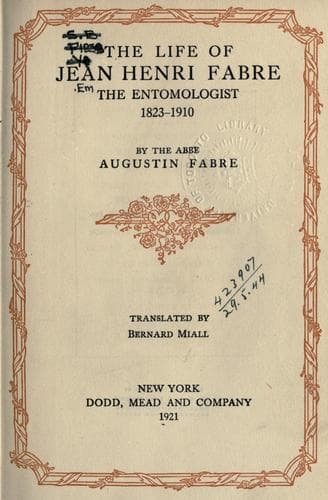
The life of Jean Henri Fabre, the entomologist, 1823-1910Fabre, Augustin
Science
The life of Jean Henri Fabre, the entomologist, 1823-1910
Fabre, Augustin
Entomologists -- France -- Biography; Fabre, Jean-Henri, 1823-1915
Let us consider the facts.
One of these Hymenoptera whose impeccable science we were admiring just
now, a Languedocian Sphex, is busy closing the burrow in which she has
laid her egg with its store of game. We brush her aside, and plunder
her nest before her eyes. Directly the passage is free, she enters and
remains for a few moments. Then she emerges and proceeds to stop up the
cell, as though nothing were the matter, as though she had not found
her burrow empty, as though the work of closing the cell had still a
motive. [175]
The Mason-Bee, excellently endowed in the matter of boring, emerges
from her nest of mortar by piercing the earthen dome which covers it.
Let us cover the nest from which the Bee is about to emerge with a
little paper bag. If the bag is placed in contact with the nest so as
to make one piece with it, so to speak, the Bee perforates it and
liberates herself. If it is not in contact with the nest, she remains
imprisoned and will let herself die without perforating the bag.
“Here, then, are sturdy insects for whom boring tufa is mere child’s
play, which will stupidly let themselves perish imprisoned by a paper
bag,” [176] to which it does not even occur to bite a second time
through the frail envelope through which they have already bitten once
when it was, so to speak, part of the earthen enclosure.
The Wasp, which is such a marvellous architect, and so skilful a
digger, is no better able to employ her talents. During the night we
place a bell-glass over a Wasp’s nest. In the morning the Wasps issue
forth and struggle against the glass wall, but not one of them dreams
of digging at the foot of the treacherous circle. But one Wasp, of
several which have strayed from the community, coming from outside,
opens up a way to the nest under the edge of the bell-glass, which is a
natural enough proceeding for an insect returning from the fields, who
may have to gain her nest through falls of earth in the entry. But even
this particular Wasp cannot repeat the operation in order to emerge
from the bell-glass, and the whole community eventually die prisoners
after a week of futile agitation. The entomologist finds this ineptness
of the Wasp repeated in the Necrophori, who nevertheless have a great
reputation for intelligence, and, in general, in all the insects which
he has had occasion to rear under a bell-glass.
The larva is subject to the same absurdities as the adult insect. The
Scolia’s larva, which eats in such a scientific manner, is quite unable
to apply its remarkable talents the moment it is off the beaten track.
Placed on the victim’s back at a spot which is not the normal point of
attack, placed on a Cetonia-grub that is immobilised without being
paralysed, or merely removed for a moment from its position, it is no
longer able to do anything right.
Public-domain text, read in full here on John Shaqi.
Reviews
Reviews
No reviews yet
Be the first to share your thoughts on this work.
Elsewhere in the archive
Join the Discussion
Join the discussion
Sign in to leave a comment or review.
Sign InorCreate an account