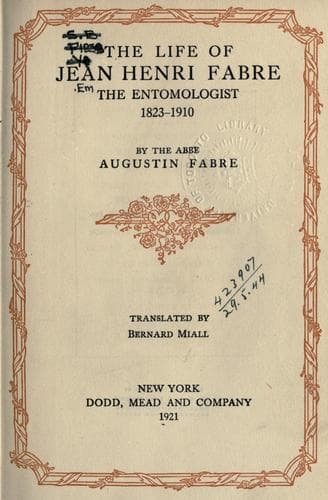
The life of Jean Henri Fabre, the entomologist, 1823-1910Fabre, Augustin
Science
The life of Jean Henri Fabre, the entomologist, 1823-1910
Fabre, Augustin
Entomologists -- France -- Biography; Fabre, Jean-Henri, 1823-1915
Yet one more of the fine arguments in support of the animal’s
reasoning powers that takes to flight in the light of
experiment.... I admire your candid faith, my masters, you who take
seriously the statements of chance observers richer in imagination
than in veracity. I admire your credulous enthusiasm, when, without
criticism, you support your theories on such stupidities. [179]
Fabre has no greater faith in the virtue of animals than in their
reason, since one cannot exist without the other. It is true that the
Copris, the most richly endowed of insects in respect of the maternal
instinct, does not differentiate between the care which she lavishes on
strangers and that which she gives to the children of her household;
but the pitiless observer shows that this is because she cannot
distinguish between them.
It is not the function of impartial history to maintain a given
thesis; it follows where the facts lead it. [180]
The historian of the insects simply confronts the facts of the
entomological world which he has explored under all its aspects:
To speak with certainty, we must not depart from what we really
know. I am beginning to know the insect passably well after forty
years of intercourse with it. Let us question the insect: not the
first comer, but the best endowed, the Hymenopteron. I am generous
to my opponents. Where will you find a creature richer in
talents?... Well, does this refined and privileged member of the
animal kingdom reason?
And, first of all, what is reason? Philosophy will give us learned
definitions. Let us be modest; let us stick to the simplest; we are
only dealing with animals. Reason is the faculty which refers the
effect to the cause, the means to the end, and directs the action
by making it conform to the requirements of the accidental. Within
these limits is the animal able to reason? Does it understand how
to associate a because with a why, and behave in accordance? Can
it, confronted with an accident, alter its line of conduct? [181]
To all these questions the facts already cited have replied. It is
evident that the Hymenopteron which provisions or closes the nest found
empty under the conditions which we have seen imposed upon the Sphex or
the Pelopæus, is ignorant of the why of her work and does not in any
case connect it with its natural aim, which is the rearing of the
larvæ.
These expert surgeons, these marvellous anatomists know nothing
whatever, not even what their victims are intended for. Their
talent, which confounds our reason, is devoid of a shadow of
consciousness of the work accomplished, a shadow of foresight
concerning the egg. [182]
Public-domain text, read in full here on John Shaqi.
Reviews
Reviews
No reviews yet
Be the first to share your thoughts on this work.
Elsewhere in the archive
Join the Discussion
Join the discussion
Sign in to leave a comment or review.
Sign InorCreate an account