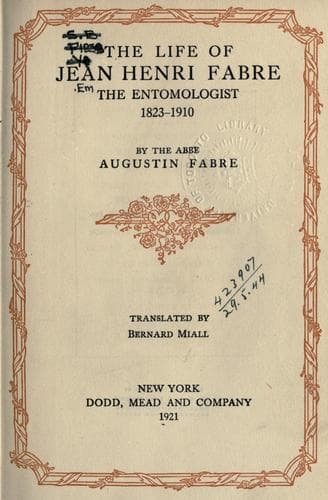
The life of Jean Henri Fabre, the entomologist, 1823-1910Fabre, Augustin
Science
The life of Jean Henri Fabre, the entomologist, 1823-1910
Fabre, Augustin
Entomologists -- France -- Biography; Fabre, Jean-Henri, 1823-1915
Fabre, then, has vainly sought for “proofs” of the intervention of
reason in the actions of the insect. He has not found them. He has even
found the very contrary; the insect, interrogated as to its powers of
reason and “the logic attributed to it,” has plainly replied that it is
entirely lacking in reason and that logic is not its strong point.
Yet he is far from wishing to “belittle the merits” or “diminish the
reputation” of his beloved insects. No one can be less suspected of
prejudice against them, since none has “glorified” them more
abundantly; no one has spoken of them with greater admiration and
sympathy; no one has more fully described their high achievements, and
no one has revealed such unknown and incredible marvels on their
behalf. It is enough to recall the “miracles” of the science and wisdom
of the paralysers.
But far from invalidating the conclusion drawn from the obvious
stupidity of the insect even in the actions which are its specialty,
the science and wisdom of instinct afford it a striking confirmation.
The very “slightest glimmer of intelligence” would suffice to make the
insect do what it does not and leave undone what it does even within
the circumference of its attributions. If it is plainly devoid of this
glimmer, how much more plainly is it devoid of that “splendour of
intelligence” which the “miracles” of instinct would require! [183] To
sum up, the insect sins too greatly by excess and by defect in its
instinctive actions to justify our attributing to it an understanding
of these actions; we are indeed compelled absolutely to deny it any
such understanding. It does at once too much and too little; too much
for an insect’s intelligence and too little for any intelligence
whatever. Everything is against it; its knowledge as much as its
ignorance; its logic as much as its inconsequences.
So long as its circumstances are normal, the insect’s actions are
calculated most rationally in view of the object to be attained.
What could be more logical, for instance, than the devices employed
by the Hunting Wasp when paralysing her prey so that it may keep
fresh for her larva, while in no wise imperilling that larva’s
safety? It is pre-eminently rational; we ourselves could think of
nothing better; and yet the Wasp’s action is not prompted by
reason. If she thought out her surgery, she would be our superior.
It will never occur to anybody that the creature is able, in the
smallest degree, to account for its skilful vivisections.
Therefore, so long as it does not depart from the path mapped out
for it, the insect can perform the most sagacious actions without
entitling us in the least to attribute these to the dictates of
reason. [184]
Public-domain text, read in full here on John Shaqi.
Reviews
Reviews
No reviews yet
Be the first to share your thoughts on this work.
Elsewhere in the archive
Join the Discussion
Join the discussion
Sign in to leave a comment or review.
Sign InorCreate an account