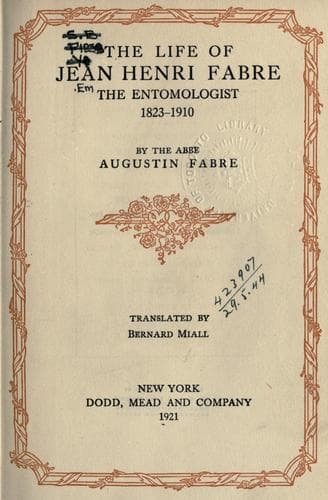
The life of Jean Henri Fabre, the entomologist, 1823-1910Fabre, Augustin
Science
The life of Jean Henri Fabre, the entomologist, 1823-1910
Fabre, Augustin
Entomologists -- France -- Biography; Fabre, Jean-Henri, 1823-1915
The Wasp acts with a precision of which science would be jealous;
she knows what man hardly ever knows; she understands the complex
nervous system of her victim.... I say, she knows and understands;
I ought to say, she acts as though she knew and understood. Her act
is all inspiration. The insect, without having any conception of
what it is doing, obeys the instinct that impels it. But whence
comes this sublime inspiration?... For me and my friend, this was
and has remained one of the most eloquent revelations of the
ineffable logic that rules the world and guides the unconscious by
the laws of its inspiration. Moved to the depths by this flash of
truth, we felt, forming upon our eyelids, tears of indefinable
emotion. [186]
The more he sees, the more he reflects, the more radiantly clear does
the meaning of these facts appear to him:
Can the insect have acquired its skill gradually, from generation
to generation, by a long series of casual experiments, of blind
gropings? Can such order be born of chaos; such foresight of
hazard; such wisdom of stupidity? Is the world subject to the
fatalities of evolution, from the first albuminous atom which
coagulated into a cell, or is it ruled by an Intelligence? The more
I see and the more I observe, the more does this Intelligence shine
behind the mystery of things. I know that I shall not fail to be
treated as an abominable “final causer.” Little do I care! A sure
sign of being right in the future is to be out of fashion in the
present.
A long time ago [says a contemporary apologist], I was discussing
matters with an astronomer who was possessed of knowledge, a
certain penetration and a certain courage. He pushed this
penetration and this courage to the length of declaring, before the
Academy of Sciences, that the laws of nature form a harmony and
reveal a plan.
I had an opportunity of congratulating him, and he was good enough
to express his satisfaction. I profited by this to suggest that he
was doubtless ready to develop his conclusions yet further, and
that since he recognised the existence of a plan he admitted, at
the origin of things, a Mind: in short, an intelligent Being.
Suddenly my astronomer turned up his nose, without offering me any
argument capable of any sort of analysis.
In vain did I explain that to deduce the existence of an
intelligent Being because one has discovered the existence of a
plan is, after all, to continue the train of reasoning which
deduces the existence of a plan after observing that there is a
system of laws. In vain I pointed out that I was merely making use
of his own argument. My astronomer refused to go any further along
the path upon which he had entered. There he would have met God,
and that was what he was unwilling to do. [187]
Public-domain text, read in full here on John Shaqi.
Reviews
Reviews
No reviews yet
Be the first to share your thoughts on this work.
Elsewhere in the archive
Join the Discussion
Join the discussion
Sign in to leave a comment or review.
Sign InorCreate an account