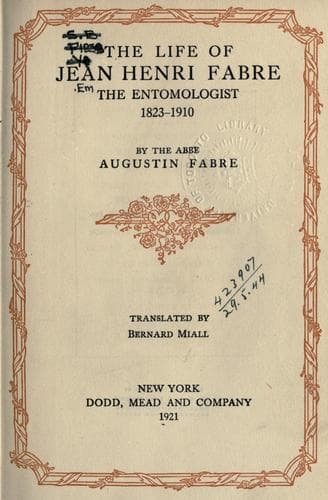
The life of Jean Henri Fabre, the entomologist, 1823-1910Fabre, Augustin
Science
The life of Jean Henri Fabre, the entomologist, 1823-1910
Fabre, Augustin
Entomologists -- France -- Biography; Fabre, Jean-Henri, 1823-1915
J. H. Fabre does not stop half-way to the truth for fear of meeting
God. He is logical, loyal, and courageous to the end. He argues from
the facts to laws and from laws to causes, and from them to the “Cause
of causes,” the “Reason of reasons,” [188] concerning which, says M.
Perrier, he has not “the pedantic feebleness of grudging it the name of
God.” [189]
If Fabre so briskly attacks the theory of evolution, it is not so much
because of the biological results which it attributes to the animal far
niente as because it offers such a convenient pretext for that sort of
intellectual laziness that willingly relies upon an explanation
provided beforehand and readily exonerates itself from the difficult
task of searching more deeply into the domain of facts as well as that
of causes. [190] If the explanation were not notoriously insufficient
one might overlook the abuses which it covers, innocently enough, but,
to speak only of the insect, all its analyses, were they admissible,
leave the problem of instinct untouched: “How did the insect acquire so
discerning an art? An eternal problem if we do not rise above the dust
to dust” [191] of evolution. At all events, as it is presented it is
merely, we repeat, “a convenient pillow for the man who has not the
courage to investigate more deeply.” [192] For him, he has this courage
and this power of ascension, and he readily spreads his wings to rise
above matter and the night of this world and soar to those radiant
heights where Divinity reveals itself, together with the supreme
explanation of the light which lightens this darkness and the life that
inspires this matter. [193]
We have said enough to show that Fabre is decidedly of the race of
those great men who soar high above the vulgar prejudices, pedantries,
and weaknesses, and whose wonderful discoveries bring them nearer to
God as they uplift them above the common level of humanity.
Having written The Harmony of the World, and casting a final glance at
the charts of the heavens and also at the long labour of his life,
Kepler offered his God this homage:
O Thou, who by the light of Nature hast caused us to sigh after the
light of grace, in order to reveal unto us the light of Thy glory,
I thank Thee, my Creator and my God, that Thou hast permitted me to
admire and to love Thy works. I have now finished the work of my
life with the strength of the understanding which Thou hast
vouchsafed me; I have recounted to men the glory of Thy works, in
so far as my mind has been able to comprehend their infinite
majesty.... Praise the Creator, O my soul! It is by Him and in Him
that all exists, the material world as well as the spiritual world,
all that we know and all that we do not know as yet, for there
remains much for us to do that we leave unfinished....
Public-domain text, read in full here on John Shaqi.
Reviews
Reviews
No reviews yet
Be the first to share your thoughts on this work.
Elsewhere in the archive
Join the Discussion
Join the discussion
Sign in to leave a comment or review.
Sign InorCreate an account