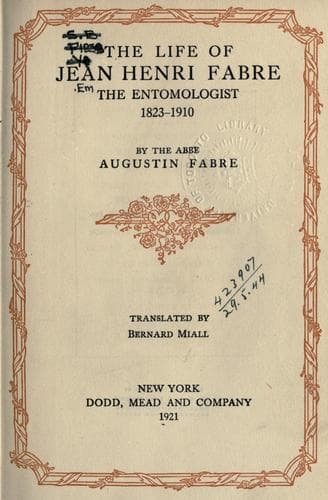
The life of Jean Henri Fabre, the entomologist, 1823-1910Fabre, Augustin
Science
The life of Jean Henri Fabre, the entomologist, 1823-1910
Fabre, Augustin
Entomologists -- France -- Biography; Fabre, Jean-Henri, 1823-1915
One reflection naturally occurs to us here, and it is rather an attempt
to be just than a plea pro domo. Because once in his life the great
naturalist was confronted by the hostility of certain persons belonging
to the world of religion, need we erase from his carefully secularised
history all that connects him with the Church, from the motherly
caresses of the “holy woman” who assuaged his first griefs to the
tender care of the worthy Sister who consoled his last sufferings? Must
we forget that he was admitted as pupil-teacher to the lycée at Rodez,
as pupil to the seminary of Toulouse and the Normal College of Avignon
on the recommendation of M. l’Abbé d’Aiguillon-Pujol, his old Rodez
headmaster? Are we to say nothing of his articles in the Revue
scientifique of Brussels, one of the principal organs of Catholic
science, or of his very important contributions to the classic series
published under the editorship of M. l’Abbé Combes? If we are, rightly,
deeply interested in the smallest details of his life and all that
concerns him, are we to say nothing of his friendly relations with his
curé [202] or of the religious practices of his family and household,
or of his generous participation in all the works of charity in his
parish, not excepting the free school?
“Neither of Armagnac nor a Burgundian”; neither secular nor clerical.
The truth is that if we consider the matter candidly, without bandaging
our eyes and without exclusive prejudice, Fabre should serve as a bond
of union rather than a bone of contention.
The ex-Director of the Beaux-Arts, Henry Roujon, who was a fervent
apostle of national concord, used to say: “Statutes are only lastingly
beautiful if the sons of the same mother can inaugurate them without
railing at one another.”
Fabre, according to this maxim, might well have statues erected to him.
And speaking of statues, we must not, having mentioned the orators,
forget the artists. All the illustrated periodicals had already
popularised the original, eloquent physiognomy of our hero. This was
too ephemeral a homage for his admirers. His features must be chiselled
in marble and exposed under the blue sky to the delighted and
affectionate eyes of his compatriots. Provence was the first to propose
the idea. Le Rouergue followed. Avignon, Orange, and Sérignan each
wanted their monument. Saint-Léons profited by its right of seniority
to take precedence of Rodez and Maillane.
“Nous voulions te fêter vivant
Doux patriarche et grand savant,
Et fier amant de la nature,
Et le Rouergue où tu nacquis
Et la Provence où tu conquis
Le laurier d’or qui toujours dure.” [203]
(We wished to honour you living,
Gentle patriarch and great scientist,
And proud lover of Nature,
Both Le Rouergue where you were born,
And Provence where you won
The golden laurel that lasts for ever.)
Public-domain text, read in full here on John Shaqi.
Reviews
Reviews
No reviews yet
Be the first to share your thoughts on this work.
Elsewhere in the archive
Join the Discussion
Join the discussion
Sign in to leave a comment or review.
Sign InorCreate an account