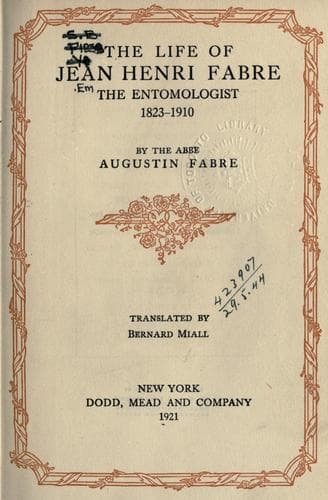
The life of Jean Henri Fabre, the entomologist, 1823-1910Fabre, Augustin
Science
The life of Jean Henri Fabre, the entomologist, 1823-1910
Fabre, Augustin
Entomologists -- France -- Biography; Fabre, Jean-Henri, 1823-1915
The first subscription-list was opened by the Normal College of
Avignon, and a special appeal was made to the schoolmasters of Vaucluse
and the rest of France. Other appeals were addressed to all without
distinction, and the subscriptions flowed in from all sides, from
scientists and men of letters, priests and schoolmasters, bourgeois and
workers in town and country, to whom it was explained that the statue
was in honour of one of themselves who had achieved greatness by his
labours.
He himself, in his modesty, wished all to regard him only as a diligent
student.
“Master,” ventured an intimate of the harmas one day, “they are talking
of putting up a statue of you close by here.”
“Well, well! I shall see myself, but shall I recognise myself? I’ve had
so little time for looking at myself!”
“What inscription would you prefer?”
“One word: Laboremus.”
What lesson was ever more necessary than this eloquent reminder of the
great law of labour! But this grand old man, who by labour has achieved
fame, teaches us yet another lesson of even rarer quality.
Let us hear him confiding his impressions to a friend: “The Mayor of
Sérignan, it seems, proposes to erect a bust of me. At this very moment
I have, staying in the house, the sculptor Charpentier, who is making
my statue for a monument they are going to set up in the Normal College
of Avignon. In my opinion there’s a good deal of the beautiful saints
about it!” [204]
This reminds us of a remark whispered into a neighbour’s ear on the
occasion of the jubilee celebrations, in the midst of all the
fashionable folk by whom he was surrounded: “I must be very queer to
look at!”
Here is a more sober if not more weighty remark. One day some one was
reminding him, in my presence, of all the marks of honour lavished upon
him during his last two days. I heard him reply quickly with the famous
apostrophe: Ματαιότης ματαιοτήτων, καὶ πάντα ματαιότης. [205]
He had another manner, perhaps still more expressive, of rendering the
same idea: he would puff into the air a cloud of smoke from his pipe,
which never left him, and, before the blue vanishing spiral: “That,” he
would say, “is human glory!”
Here we recognise the man whom Rostand represented as follows in the
verses inscribed upon a bas-relief which makes his collection of
sonnets, entitled Fabre-des-Insectes, as it were the pendant of
Charpentier’s monument:
“C’est un homme incliné, modeste et magistral,
Pensif—car dans ses doigts il a tenu des ailes
Poursuivant les honneurs moins que les sauterelles.”
(A man who stoops, modest and magisterial,
Thoughtful—for in his fingers he has held wings,
Pursuing honours less than the grasshoppers.)
II
The fine and unusual qualities of Fabre’s career consist in this; he
has attained fame while seeking nothing but truth: and what a
truth!—the truth concealed in the humblest of created things!
Public-domain text, read in full here on John Shaqi.
Reviews
Reviews
No reviews yet
Be the first to share your thoughts on this work.
Elsewhere in the archive
Join the Discussion
Join the discussion
Sign in to leave a comment or review.
Sign InorCreate an account