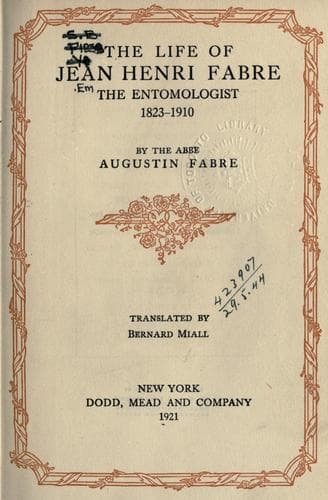
The life of Jean Henri Fabre, the entomologist, 1823-1910Fabre, Augustin
Science
The life of Jean Henri Fabre, the entomologist, 1823-1910
Fabre, Augustin
Entomologists -- France -- Biography; Fabre, Jean-Henri, 1823-1915
Before Fabre’s time entomology was a poor little science, with no
savour of life or freshness about it, without a ray of sunshine,
without a soul; like those poor little insects under glass or stuck on
pins, which it was its mission to study.
In his hands and in his books, as though by magic, entomology became
truly a living science, provided with wings—the wings of imagination
and poetry, of thought and philosophy.
It is a far cry from the dense materialism of the “dust-to-dust”
scientists who content themselves with dissecting poor little murdered
bodies to the winged spiritualism of this open-air entomologist,
interrogating with his bright, loving glance these little insect souls,
at once so wonderful and so unconscious. And they all tell him the same
thing: Ipse fecit nos et non ipsi nos. [206] (It is He that hath made
us, and not we ourselves.)
Some one has said, and it is a saying worth repeating, so just and
admirable is it, and so characteristic of the man and his work: With
Fabre we have every moment, so to speak, the feeling, the surprise, of
rising toward the infinitely great while stooping over the infinitely
little.
Of this scientist, this philosopher, whose mind soars so readily from
the “little things” to the great, to the “very great,” from the little
curiosities of observation to the great problems that are to be
encountered in the higher domains of thought, his friends conceived the
idea of demanding a synthesis of the reflections scattered through the
pages of the Souvenirs.
This was his reply:
Because I have shifted a few grains of sand upon the shore, am I in
a position to understand the abysmal depths of the ocean? Life has
unfathomable secrets. Human knowledge will be erased from the
world’s archives before we know the last word concerning a gnat.
Thus the Homer, the Plato of the insects. He is utterly unassuming. He
will not allow his admirers to impose upon him. He does not allow
himself to be snared by the lure of vivid, brilliant language, nor by
the intoxicating problems of inner truths whose surface he grazes.
According to him the sum of all his work has been but to “shift a few
grains of sand upon the shore” of knowledge, and it is useless for him
to endeavour to sound the mysteries of life; he has not even learned—he
does not even think it possible to human knowledge to learn—“the last
word concerning a gnat.”
Does this imply that he has relapsed into scepticism; that finally, in
despair, he renounces the ambition of his whole life, vitam impendere
vero? By no means. He has striven to attain it even beyond his
strength.
When he considers himself incapable of adding further volumes to his
work he busies himself with preparing a definitive edition, and in a
touching farewell to his beloved studies he declares that they are so
full of charm and unexplored marvels that could he live several lives
he would devote them all to them without ever succeeding in “exhausting
their interest.”
Public-domain text, read in full here on John Shaqi.
Reviews
Reviews
No reviews yet
Be the first to share your thoughts on this work.
Elsewhere in the archive
Join the Discussion
Join the discussion
Sign in to leave a comment or review.
Sign InorCreate an account