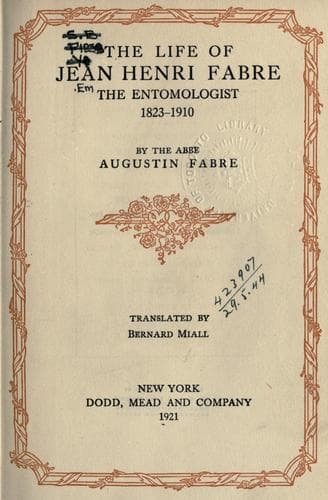
The life of Jean Henri Fabre, the entomologist, 1823-1910Fabre, Augustin
Science
The life of Jean Henri Fabre, the entomologist, 1823-1910
Fabre, Augustin
Entomologists -- France -- Biography; Fabre, Jean-Henri, 1823-1915
Meditating upon his history, with its full days and hours, Fabié, in a
delightful flight of imagination, shows us the harassed entomologist
escaping from the past to find himself alone with his thoughts and his
beloved insects. “He slips silently to the gate of his harmas. There he
lies down on a bank thickly carpeted with lavender and withered
couch-grass”.... A few moments pass. His children intervene: “he is
relaxing himself, stretching himself, soothed, happy as a little
child.—‘But, father, you aren’t thinking! When the dew is falling!’
‘Ah, my children, why did you wake me? I was having such a beautiful
dream!’ For in his sleep he had entered into conversation with the
crickets of his native country-side.”
Fatigue of the body, weariness of the mind, and a breaking heart!
Suffering pressed closely upon him at the close of his days.
“It is better to be loved than to be celebrated,” said Aubanel, the
delicate poet of Avignon. As long as Fabre had beside him his beloved
brother, his adored wife, and his darling children, he was at least
conscious of a kindly atmosphere of memories, and of tenderness that
made up for what he lacked and helped him to endure his afflictions
with serene resignation.
But now, little by little, there came a void about him. Death has its
surprises and life its demands.
With the death of his wife, in July 1912, half his own soul died. With
that of his brother, in 1913, his life was almost wholly shattered,
crushed, buried in the tomb.
With the marriage of the last of his sons and his two youngest
daughters almost all the life of the house, all the caressing grace of
light, considerate footfalls, of clear tender voices, of smiles and
kisses, had forsaken the old man, to return only in passing and at
distant intervals. His isolation became more and more complete.
Was all over? No, this was hardly the beginning of his afflictions. In
the great silence of the harmas there burst of a sudden the terrible
thunderclap of war which roused to a protest of intolerable grief the
uttermost fibres of his being.
The whole man suffered. The Frenchman, to see his beloved country the
victim of the brutal and underhand aggression of a predatory nation:
the father to see his dear children, a son and two sons-in-law, cast
into the furnace; the idealist and the great-hearted man who had held
war to be a relic of barbarism, doomed to disappear from the annals of
the human race, to see war declared, and spreading with the violence of
a conflagration, surpassing in horror all that history tells us of the
armed conflicts of the past.
Before the bloody vision of the battlefields, how should he not feel
shaken to the depths of his being by the tremors of a terrible anger
and a vast pity, he who had never been able to see an insect suffering
without a pang at the heart?
Public-domain text, read in full here on John Shaqi.
Reviews
Reviews
No reviews yet
Be the first to share your thoughts on this work.
Elsewhere in the archive
Join the Discussion
Join the discussion
Sign in to leave a comment or review.
Sign InorCreate an account