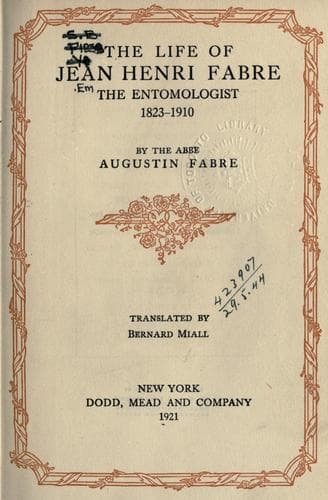
The life of Jean Henri Fabre, the entomologist, 1823-1910Fabre, Augustin
Science
The life of Jean Henri Fabre, the entomologist, 1823-1910
Fabre, Augustin
Entomologists -- France -- Biography; Fabre, Jean-Henri, 1823-1915
True, in his incomparable Iliad, the Homer of the Insects had often
described creatures that hunt one another, kill one another, devour one
another with indescribable ardour and ferocity, and he knew that he had
only written a chapter of that “struggle for life” which is to be found
on every step of the biological ladder, with the same disregard of
weakness and suffering.
But he would fain have seen man assert his superiority over the animals
by repressing these instincts, which come from below, by the free
flight of the aspirations vouchsafed from above, by the progressive
subordination of the brute power of force to the spiritual power of
justice and love.
While these distressing problems were filling his mind, and while, in
protest against happenings so utterly contrary to his ideas, he would
thump his fist upon his famous little table, a woman was moving gently
to and fro, playing the parts, alternately, with the same calm
countenance, of Martha and of Mary; and when he asked her her secret,
she showed him her crucifix and read the Gospel to him, as though to
wring from his heart the cry that was uttered by the poet of La Bonne
Souffrance: [207]
“Vingt siècles de bonté sont sortis de ces mystères,
Je crois en toi, Jésus....”
In moments of affliction, Fabre is even closer to the Truth than on the
heights of knowledge and fame. For we are never nearer the God of the
Gospel than when we most feel the want of Him.
IV
More than ninety years of life and almost as many of labour, nearly
five years of overwhelming fame, and almost as many of unspeakable
suffering: must not a man be “built of heart of oak,” as they say in
Aveyron, to survive so many trials?
Like the oaks of his native parts, the patriarch of Sérignan continued
to brave the assaults of time, and even when he began to feel that his
life was declining, it seemed as though it was only withdrawing itself
from its long and manifold ramifications in the external world to take
refuge, as in an inexpugnable asylum, in the depths and roots of his
being. He was one of those of whom people say with us that they “cannot
die.”
Fabre’s work is immortal—that is agreed. But the artisan?
Let us resume our comparison. Like the oak that loses its boughs, one
after the other, he saw falling one by one the several factors of his
life. His life was the harmas, that paradise of insects, that
laboratory after his own heart, where he could make his observations
under the blue sky, to the song of the Cicadæ, amid the thyme,
lavender, and rosemary. Now he was seen there no longer; hardly were
the traces of his footsteps yet visible through the untrimmed boughs
that crossed the paths and the grass that was invading them.
Public-domain text, read in full here on John Shaqi.
The life of Jean Henri Fabre, the entomologist, 1823-1910 — John Shaqi
Reviews
Reviews
No reviews yet
Be the first to share your thoughts on this work.
Elsewhere in the archive
Join the Discussion
Join the discussion
Sign in to leave a comment or review.
Sign InorCreate an account