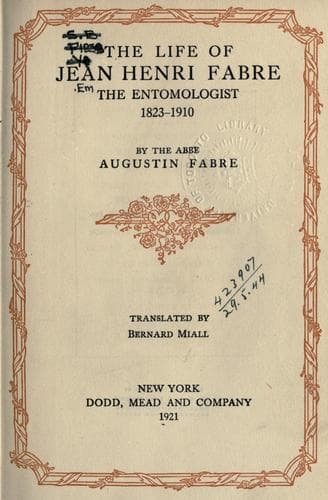
The life of Jean Henri Fabre, the entomologist, 1823-1910Fabre, Augustin
Science
The life of Jean Henri Fabre, the entomologist, 1823-1910
Fabre, Augustin
Entomologists -- France -- Biography; Fabre, Jean-Henri, 1823-1915
“And when one evening,” says his friend, “I remarked that these little
miracles clearly proved the existence of a divine Artificer: ‘For me, I
do not believe in God’ declared the scientist, repeating for the last
time his famous and paradoxical profession of faith: ‘I do not believe
in God, because I see Him in all things and everywhere.’”
Another day he expressed his firm and profound conviction to the same
friend, in a slightly different form. “God is Light!” he said
dreamily.—“And you always see Him shining?” “No,” he said suddenly,
“God does not shine; He obtrudes Himself.”
The man who thus bows before God has truly attained, on the heights of
human knowledge, what we may call with him the threshold of eternal
life. To him God sends His angels to open the gates, that he may enter
by the straight paths of the Gospel and the Church.
After the death of Mme. Fabre in 1912, a nursing Sister of the
Congregation of Saint-Roch de Viviers was installed at the Harmas; her
name was Sister Adrienne.
The old man appreciated her services so greatly that he was overcome
with dejection by the very thought that she might be recalled by her
superiors, according to the rule of her Order, after the lapse of a
certain period of time. And he would gratefully press her hand when the
good Sister sought to relieve his anxiety and inspire him with the hope
that she would be allowed to remain in his service till the end of his
days.
He found her simplicity, her delicacy, her good nature, and her
devotion so delightful that he could not refrain from telling her so
plainly in the direct, forcible manner familiar to him: “You are
invaluable, Sister; you are admirable. I love religion as you practise
it.”
“He has often told me,” she writes, “that when he could not sleep at
night, he used to pray, to think of God, and address to Him a prayer
which he would himself compose.”
In the spring of 1914 the aged naturalist, who was more than ninety
years of age, felt that his strength was failing more perceptibly, so
that the doctors diagnosed a fatal outcome in the near future.
On receiving the news of this alarming condition, Monseigneur the
Archbishop of Avignon hastened to the Harmas. The invalid expressed his
delight and gratitude for the visit. Their relations were so cordial
that the prelate decided to continue them by a series of admirable
letters which have fortunately been published.
In these letters, with great delicacy, Monseigneur Latty avoided all
that might run contrary to the naturalist’s opinions, and very gently
endeavoured to induce him to die as a Christian.
To draw him more surely to the light that shines from the Cross and the
grace which raises the soul above itself, he asks him to recite every
evening, in unison with him, the beautiful prayer of the dying Saviour,
which he calls “the prayer of the heights,” the height of Golgotha, the
height of life: In manus tuus Domine commendo spiritum meum. (Into Thy
hands, O Lord, I commend my spirit.)
Public-domain text, read in full here on John Shaqi.
Reviews
Reviews
No reviews yet
Be the first to share your thoughts on this work.
Elsewhere in the archive
Join the Discussion
Join the discussion
Sign in to leave a comment or review.
Sign InorCreate an account