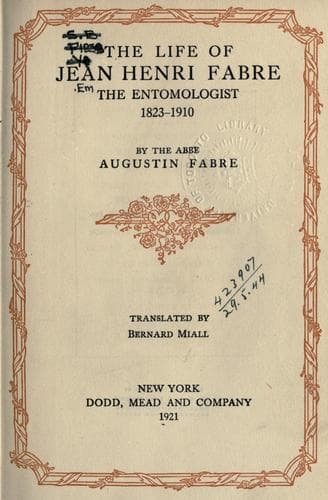
The life of Jean Henri Fabre, the entomologist, 1823-1910Fabre, Augustin
Science
The life of Jean Henri Fabre, the entomologist, 1823-1910
Fabre, Augustin
Entomologists -- France -- Biography; Fabre, Jean-Henri, 1823-1915
However, the soul of the “good sage” which they thus sought to capture
and hold here on earth—in short, to imprison in his work and its
environment—made its escape and took flight toward loftier regions and
wider horizons.
To see him in the twilight of the dining-room where he silently
finished his life, majestically leaning back in his arm-chair, with his
best shirt and old-fashioned necktie, his eyes still bright in his
emaciated face, his lips fine and still mobile, but thin with age and
at moments trembling with emotion, or moved by a sudden inspiration—to
see him thus, would you not say that he was still observing? Yes, but
his observations are now of an invisible world, a world even richer in
mysteries and revelations than the world below, so patiently explored
for more than fifty years.
One day, when two professors of the Grand-Séminaire de
Saint-Paul-Trois-Châteaux [209] had come to see him, as the time drew
near to bid them good-bye, the old man held out his hands and tucked
them under their arms, and, not without difficulty, rose from his
arm-chair, and arm-in-arm with them advanced, tile by tile, to the
threshold of the house, whither he had determined to accompany them.
Suddenly, pressing their arms more closely and alluding to their
cassocks and their vocation, he said, energetically: “You have chosen
the better part”; and, holding them back for a last word, he added:
“Life is a horrible phantasmagoria. But it leads us to a better
future.”
This future the naturalist liked to conceive in accordance with the
images familiar to his mind, as being a more complete understanding of
the great book of which he had deciphered only a few words, as a more
perfect communion with the offices of nature, in the incense of the
perfumes “that are softly exhaled by the carven flowers from their
golden censers,” amid the delightful symphonies in which are mingled
the voices of crickets and Cicadæ, chaffinches and siskins, skylarks
and goldfinches, “those tiny choristers,” all singing and fluttering,
“trilling their motets to the glory of Him who gave them voice and
wings on the fifth day of Genesis.” [210]
This last passage might be underlined, for now more than ever, in our
thoughts of this scientist, of whom it has been said that “with a taste
for Nature he has given us an appreciation of God,” the work cannot be
divorced from the artisan without the grossest inconsistency.
One who had the good fortune to become intimate with Fabre during the
last days of his life tells how eagerly the naturalist used to accept
the wild flowers which he brought in from his walks, how tenderly he
would caress them with his frail fingers and brilliant eyes. Both looks
and gestures expressed an infinite admiration for the pure and simple
work of Nature as God has ordained it:
Public-domain text, read in full here on John Shaqi.
Reviews
Reviews
No reviews yet
Be the first to share your thoughts on this work.
Elsewhere in the archive
Join the Discussion
Join the discussion
Sign in to leave a comment or review.
Sign InorCreate an account