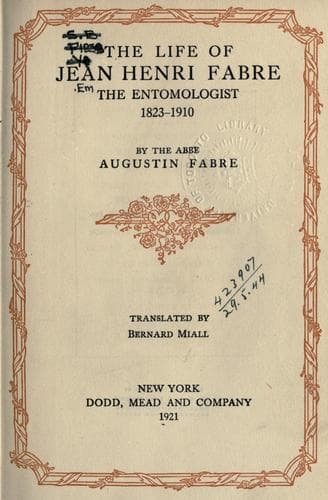
The life of Jean Henri Fabre, the entomologist, 1823-1910Fabre, Augustin
Science
The life of Jean Henri Fabre, the entomologist, 1823-1910
Fabre, Augustin
Entomologists -- France -- Biography; Fabre, Jean-Henri, 1823-1915
And arithmetic? Yes, we did a little of this, but not under that
learned name. We called it sums. To put down rows of figures, not
too long, add them and subtract them one from the other was more or
less familiar work. On Saturday evenings, to finish up the week,
there was a general orgy of sums. The top boy stood up and, in a
loud voice, recited the multiplication table up to twelve times. I
say twelve times, for, in those days, because of our old duodecimal
measures, it was the custom to count as far as the twelve-times
table, instead of the ten-times of the metric system. When this
recital was over, the whole class, the little ones included,
shouted it in chorus, creating such an uproar that chicks and
porkers took to flight if they happened to be there. And this went
on to twelve times twelve, the first in the row starting the next
table and the whole class repeating it as loud as it could yell. Of
all that we were taught in school, the multiplication table was
what we knew best, for this noisy method ended by dinning the
different numbers into our ears. This does not mean that we became
skilful reckoners. The cleverest of us easily got muddled with the
figures to be carried in a multiplication sum. As for division,
rare indeed were they who reached such heights. In short, the
moment a problem, however insignificant, had to be solved, we had
recourse to mental gymnastics much rather than to the learned aid
of arithmetic.
This account cannot be suspected of any malicious exaggeration: the
narrator is too full of sympathy for his old master to do him anything
less than justice. In any case he bears him no grudge in respect of the
deficiencies of his teaching:
When all is said, our master was an excellent man who could have
kept school very well but for his lack of one thing: and that was
time. He devoted to us all the little leisure which his numerous
functions left him. And first of all, he managed the property of an
absentee landowner, who only occasionally set foot in the village.
He had under his care an old castle with four towers, which had
become so many pigeon-houses; he directed the getting-in of the
hay, the walnuts, the apples, and the oats. We used to help him
during the summer, when the school, which was well attended in
winter, was almost deserted. The few who remained, because they
were not yet big enough to work in the fields, were small children,
including him who was one day to set down these memorable facts.
Lessons were less dull at that time of year. They were often given
on the hay or the straw; oftener still, lesson-time was spent in
cleaning out the dovecot or stamping on the snails that had sallied
in rainy weather from their ramparts, the tall box borders of the
garden belonging to the castle.
Public-domain text, read in full here on John Shaqi.
Reviews
Reviews
No reviews yet
Be the first to share your thoughts on this work.
Join the Discussion
Join the discussion
Sign in to leave a comment or review.
Sign InorCreate an account