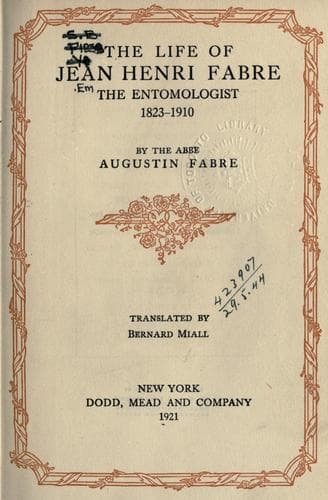
The life of Jean Henri Fabre, the entomologist, 1823-1910Fabre, Augustin
Science
The life of Jean Henri Fabre, the entomologist, 1823-1910
Fabre, Augustin
Entomologists -- France -- Biography; Fabre, Jean-Henri, 1823-1915
[51] However, the audacious insect had other surprises in store for
him: his notes speak of nests found more or less by chance near the
still of a distillery, on the top of a steam-engine in a silk mill, on
the walls and furniture of a farmhouse kitchen, and even in the
interior of a gourd in which the farmer kept his shot on the
chimney-piece; in a word, wherever there was warmth and not too much
light. Souvenirs, IV., p. 8–12.
[52] Souvenirs, I., p. 122. The Hunting Wasps, chap. vii., “Advanced
Theories.”
[53] Souvenirs, I., p. 136. The Hunting Wasps, chap. viii., “The
Languedocian Sphex.”
[54] Souvenirs, I., pp. 50, 52; II., p. 262 et seq.
[55] Souvenirs, II., pp. 262–303, III., 194–195. The Glow-Worm, chap.
ii., “The Sitaris;” The Life of the Fly, chap. iv., “Larval
Dimorphism.”
[56] Horace, Ars Poetica, 409 et seq.
[57] Souvenirs, III., p. 193.
[58] Ibid., I., p. 182. The Hunting Wasps, chap. xi., “An Ascent of
Mont Ventoux.”
[59] Souvenirs, I., pp. 182–3. The Hunting Wasps, chap. xi., “An Ascent
of Mont Ventoux.”
[60] Souvenirs, I., p. 180.
[61] Th. Delacour and Bernard Valot of the Jardin des Plantes.
[62] Souvenirs, I., pp. 181–186. The Hunting Wasps, chap, xi., “An
Ascent of Mont Ventoux.”
[63] Souvenirs, I., pp. 192–193.
[64] Souvenirs, VI., p. 166; I., p. 187.
[65] Léon Dufour (1780–1865) was an Army surgeon who in 1823 went
through the Spanish campaign, and on returning to France settled in his
native town, Saint-Sever, where he devoted himself chiefly to
entomology.
[66] Souvenirs, I., pp. 39–41. The Hunting Wasps, chap, i., “The
Buprestis-hunting Cerceris.”
[67] Fabre, Poet of Science, p. 58.
[68] Souvenirs, I., pp. 41, 44. The Hunting Wasps, chap. I., “The
Buprestis-hunting Cerceris.”
[69] Souvenirs, IX., pp. 326–328.
[70] Duclaux, Pasteur, Histoire d’un Esprit, pp. 182–93.
[71] Souvenirs, IX., p. 330.
[72] Souvenirs, IX., pp. 330–331.
[73] Souvenirs, I., p. 40, 73; II., pp. 78, 83, 181, 214, 234, 235,
283; V., pp. 76, 188, 229, etc.
[74] Everybody knows to-day that heat kills, or so far enfeebles as to
render inoffensive, the microbes that infect liquids and make it
impossible to preserve them.
This again is one of Pasteur’s happy discoveries, as is conveyed by the
very verb to pasteurise, which means “to protect against microbes by
the action of heat.” We pasteurise milk, beer, wine, etc.
The ancients used to practise the heating of wines. In the house of St.
John and St. Paul, discovered in Rome in 1887, beneath the church
dedicated to the two martyrs, who were both officers of the Emperor
Constantine, the excavators found beside the cellar and the amphoræ of
wine, the little room with a fireplace known as the furnarium, which
was used for heating wine and drying fruit.
The heating of wines was practised also at Mèze, near Cette, before
Pasteur’s discovery.
Public-domain text, read in full here on John Shaqi.
Reviews
Reviews
No reviews yet
Be the first to share your thoughts on this work.
Elsewhere in the archive
Join the Discussion
Join the discussion
Sign in to leave a comment or review.
Sign InorCreate an account