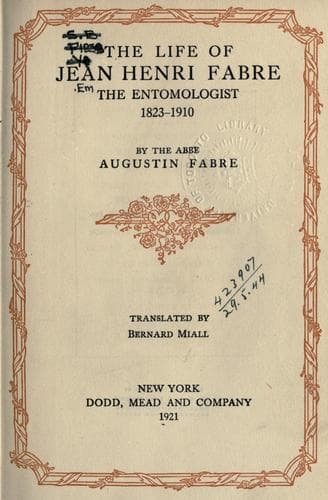
The life of Jean Henri Fabre, the entomologist, 1823-1910Fabre, Augustin
Science
The life of Jean Henri Fabre, the entomologist, 1823-1910
Fabre, Augustin
Entomologists -- France -- Biography; Fabre, Jean-Henri, 1823-1915
But the ancient method of heating had nothing in common with
pasteurisation. The merchants of Hérault, like the ancients, used to
heat wine in order to modify its flavour, to mature it more quickly.
Pasteur, on the other hand, heats it to keep it unchanged. To mature
wine it is heated slowly in contact with the air. To preserve it, the
wine must be rapidly heated to 122° F. in a vacuum. The object and the
method are altogether different.
[75] Souvenirs, IX., pp. 329–30.
[76] St. Roch (1295–1327) is represented in his statues with the dog
that saved his life by discovering him in the solitude where after
curing the plague-stricken Italians, he hid himself lest he should
communicate the pestilence to others.—A. T. de M.
[77] The old, partly-demolished bridge at Avignon which figures in the
well-known French catch:
“Sur le pont d’Avignon,
Tout le monde y danse en rond.”
(A. T. de M.)
[78] Souvenirs, X., pp. 343 et seq. The Life of the Fly, chap xx.,
“Industrial Chemistry.”
[79] M. François Fabié, ex-professor in the lycée of Toulon, still
lives in the neighbourhood of the city, in the Villa des Troènes.
[80] Journal d’Aveyron, 8 November 1908.
[81] Souvenirs, X., pp. 338–43; The Life of the Fly, chap. xx.,
“Industrial Chemistry.”
[82] Cf. supra, p. 135.
[83] Souvenirs, X., p. 353. The Life of the Fly, chap. xx., “Industrial
Chemistry.”
[84] Revue scientifique, May 7, 1910, speech by M. Edmond Perrier.
[85] Jean Victor Duruy (1811–1894), author of a number of historical
works, including a well-known Histoire des Romains, and Minister of
Public Instruction under Napoleon III. from 1863 to 1869. Cf. The Life
of the Fly, chap. xx.—A. T. de M.
[86] Souvenirs, II., pp. 125–126. The Mason Bees, chap. V., “The story
of my Cats.”
[87] Horace, Ode xxx., Bk. iii.
[88] Souvenirs, II., pp. 202–203. The Life of the Spider, chap. i.,
“The Black-bellied Tarantula.”
[89] Souvenirs, II., p. 1.
[90] The Halicti produce two generations each year: one, in the spring,
is the issue of mothers who, fecundated in the autumn, have passed
through the winter; the other, produced in the summer, is the fruit of
parthenogenesis, that is, of procreation by the maternal virtualities
alone. Of the concourse of the two sexes only females are born;
parthenogenesis gives rise to both males and females.
[91] Souvenirs, VIII., pp. 144–160. The Bramble-Bees, chap. xiv.,
“Parthenogenesis.” It was only a later date, by combining a series of
successive observations which were spread over a great length of years,
that he was able to define exactly the various modes of generation
employed by the Halicti, as described in the preceding note.
[92] Fabre, Poet of Science, G. V. Legros, pp. 108–115.
[93] The country round Sérignan, in Provence.—A. T. de M.
[94] Souvenirs, II., pp. 1–8. The Life of the Fly, chap. i., “The
Harmas.”
Public-domain text, read in full here on John Shaqi.
Reviews
Reviews
No reviews yet
Be the first to share your thoughts on this work.
Elsewhere in the archive
Join the Discussion
Join the discussion
Sign in to leave a comment or review.
Sign InorCreate an account