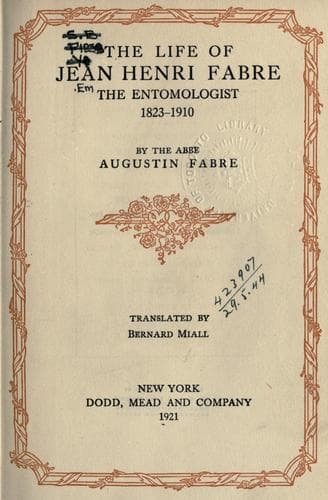
The life of Jean Henri Fabre, the entomologist, 1823-1910Fabre, Augustin
Science
The life of Jean Henri Fabre, the entomologist, 1823-1910
Fabre, Augustin
Entomologists -- France -- Biography; Fabre, Jean-Henri, 1823-1915
There are beds with box-borders in that garden; there are
pear-trees reputed to give pears, real pears, more or less good to
eat when they have ripened on the straw all through the late
autumn. In our imagination, it is a spot of perpetual delight, a
paradise, but a paradise seen the wrong way up: instead of
contemplating it from below, we gaze at it from above. How happy
they must be with so much space and all those pears!
We look at the hives, around which the hovering Bees make a sort of
russet smoke. They stand under the shelter of a great hazel. The
tree has sprung up all of itself in a fissure of the wall, almost
on the level of our currant-bushes. While it spreads its mighty
branches over the notary’s hives, its roots, at least, are in our
soil. It belongs to us. The trouble is to gather the nuts.
I creep along astride the strong branches projecting horizontally
into space. If I slip, or if the support breaks, I shall come to
grief in the midst of the angry Bees. I do not slip, and the
support does not break. With the crooked stick which my brother
hands me, I bring the finest clusters within my reach. I soon fill
my pockets. Moving backwards, still straddling my branch, I recover
terra firma. O wondrous days of litheness and assurance, when, for
a few filberts, on a perilous perch we braved the abyss! [18]
I confess I love this little sketch of the garden, which gives evidence
of a singular clearness of perception in the gaze which this child
already turns upon the things about him.
But I like still better the history of the duck-pond, graceful as an
idyll and touching as an elegy, the idyll of a rustic childhood which
becomes aware, simultaneously, of the family secrets and the secrets of
nature; the elegy of a father’s tenderness and a son’s piety cramped
and mortified by poverty, the elegy of intelligence, nay, of genius,
ready to spread its wings and fettered in its flight by the heavy
chains and harsh necessities of material existence:
How shall a man earn his living in my poor native village, with its
inclement weather and its niggardly soil? The owner of a few acres
of grazing-land rears sheep. In the best parts, he scrapes the soil
with the swing-plough; he flattens it into terraces banked by walls
of broken stones. Pannierfuls of dung are carried up on donkey-back
from the cowshed. Then, in due season, comes the excellent potato,
which, boiled and served hot in a basket of plaited straw, is the
chief stand-by in winter.
Public-domain text, read in full here on John Shaqi.
Reviews
Reviews
No reviews yet
Be the first to share your thoughts on this work.
Join the Discussion
Join the discussion
Sign in to leave a comment or review.
Sign InorCreate an account