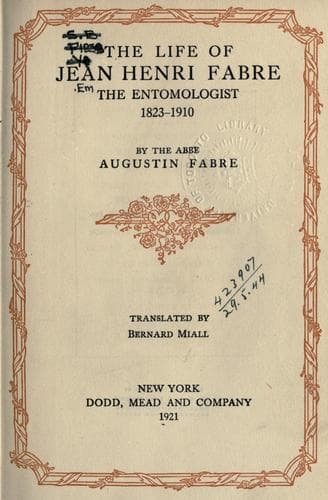
The life of Jean Henri Fabre, the entomologist, 1823-1910Fabre, Augustin
Science
The life of Jean Henri Fabre, the entomologist, 1823-1910
Fabre, Augustin
Entomologists -- France -- Biography; Fabre, Jean-Henri, 1823-1915
My delicate burden, which would be ruined by a false step, makes me
give up the remainder of the climb. Some other day I shall see the
trees on the hill-top over which the sun rises. I go down the slope
again. At the bottom I meet the parish priest’s curate reading his
breviary as he takes his walk. He sees me coming solemnly along,
like a relic-bearer; he catches sight of my hand hiding something
behind my back:
“What have you there, my boy?” he asks.
All abashed, I open my hand and show my blue egg on its bed of
moss.
“Ah!” says his reverence. “A Saxicola’s egg! Where did you get it?”
“Up there, father, under a stone.”
Question follows question; and my peccadillo stands confessed. “By
chance I found a nest which I was not looking for. There were six
eggs in it. I took one of them—here it is;—and I am waiting for the
rest to hatch. I shall go back for the others when the young birds
have their quill-feathers.”
“You mustn’t do that, my little friend,” replies the priest. “You
mustn’t rob the mother of her brood; you must respect the innocent
little ones; you must let God’s birds grow up and fly from the
nest. They are the joy of the fields, and they clear the earth of
its vermin. Be a good boy, now, and don’t touch the nest.”
I promise; and the curate continues his walk. I come home with two
good seeds cast on the fallows of my childish brain. An
authoritative word has taught me that plundering birds’ nests is a
bad action. I did not quite understand how the bird comes to our
aid by destroying vermin, the scourge of the crops; but I felt, at
the bottom of my heart, that it is wrong to afflict the mothers.
“Saxicola,” the priest had said, on seeing my find.
“Hullo!” said I to myself. “Animals have names, just like
ourselves. Who named them? What are all my different acquaintances
in the woods and meadows called? What does Saxicola mean?”
Years passed; and Latin taught me that Saxicola means an inhabitant
of the rocks. My bird, in fact, was flying from one rocky point to
the other while I lay in ecstasy before its eggs; its house, its
nest, had the rim of a large stone for a roof. Further knowledge
gleaned from books taught me that the lover of stony hill-sides is
also called the Motteux, or Clodhopper, [21] because, in the
ploughing season, she flies from clod to clod, inspecting the
furrows rich in unearthed grub-worms. Lastly, I came upon the
Provençal expression Cul-blanc, which is also a picturesque term,
suggesting the patch on the bird’s rump which spreads out like a
white butterfly flitting over the fields.
Public-domain text, read in full here on John Shaqi.
Reviews
Reviews
No reviews yet
Be the first to share your thoughts on this work.
Join the Discussion
Join the discussion
Sign in to leave a comment or review.
Sign InorCreate an account