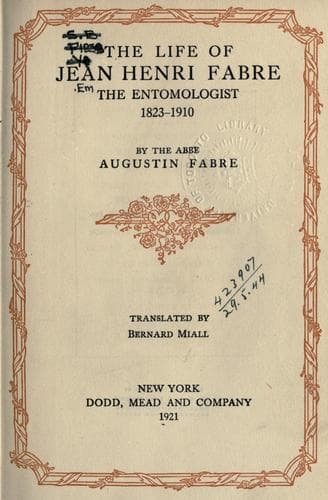
The life of Jean Henri Fabre, the entomologist, 1823-1910Fabre, Augustin
Science
The life of Jean Henri Fabre, the entomologist, 1823-1910
Fabre, Augustin
Entomologists -- France -- Biography; Fabre, Jean-Henri, 1823-1915
At the age of ten the time came for the child to bid a fresh farewell
to his native village. His father was the first of his race to be
tempted by the town, and he removed his home to Rodez. Jean-Henri was
never again to behold the humble village where he lived “his best
years,” but he bore its image indelibly stamped upon his mind, upon
that part of it in which are formed those profound impressions that
grow more vivid with the years instead of fading. He left it at first
with a light heart, but later on he was homesick for it; and as the
years went by he felt more than ever its mysterious attraction, so that
one of his last wishes was to see his grave dug in the shadow of his
cradle. But we will not wrong feelings so delicate by seeking to
interpret them; we will let him speak for himself.
Leaving our native village is no very serious matter when we are
children. We even look on it as a sort of holiday. We are going to
see something new, those magic pictures of our dreams. With age
come regrets; and the close of life is spent in stirring up old
memories. Then, in our dreamy moods, the beloved village reappears,
embellished, transfigured by the glow of those first impressions;
and the mental image, superior to the reality, stands out in
amazingly clear relief. The past, the far-off past, was only
yesterday; we see it, we touch it.
For my part, after three-quarters of a century, I could walk with
my eyes closed straight to the flat stone where I first heard the
soft chiming note of the Midwife Toad; yes, I should find it to a
certainty, if time, which devastates all things, even the homes of
Toads, has not moved it or perhaps left it in ruins.
I see, on the margin of the brook, the exact position of the
alder-trees whose tangled roots, deep under the water, were a
refuge for the Crayfish. I should say:
“It is just at the foot of this tree that I had the unutterable
bliss of catching a beauty. She had horns so long ... and enormous
claws, full of meat, for I got her just at the right time.”
I should go without faltering to the ash under whose shade my heart
beat so loudly one sunny spring morning. I had caught sight of a
sort of white, cottony ball among the branches. Peeping from the
depths of the wadding was an anxious little head with a red hood to
it. Oh, what unparalleled luck! It was a Goldfinch, sitting on her
eggs.
I know my village thoroughly, though I quitted it so long ago; and
I know hardly anything of the towns to which the vicissitudes of
life have brought me. An exquisitely sweet link binds us to our
native soil; we are like the plant that has to be torn away from
the spot where it put out its first roots. Poor though it be, I
should love to see my own village again; I should like to leave my
bones there. [23]
CHAPTER V
AT THE COLLEGE OF RODEZ
Public-domain text, read in full here on John Shaqi.
Reviews
Reviews
No reviews yet
Be the first to share your thoughts on this work.
Join the Discussion
Join the discussion
Sign in to leave a comment or review.
Sign InorCreate an account