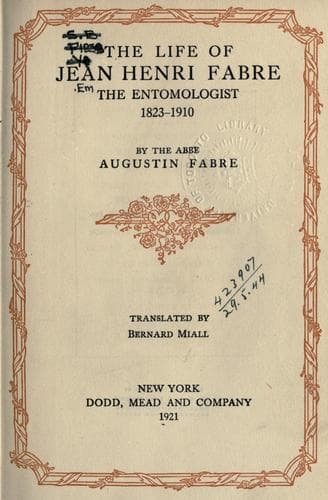
The life of Jean Henri Fabre, the entomologist, 1823-1910Fabre, Augustin
Science
The life of Jean Henri Fabre, the entomologist, 1823-1910
Fabre, Augustin
Entomologists -- France -- Biography; Fabre, Jean-Henri, 1823-1915
If he had hearkened only to his passion for Nature, the schoolboy of
Rodez would soon have become one of the most ardent disciples of the
school of the woods; that is, he would have played truant. But he was,
happily, from an early age, a worker; because industry was for him both
a family inheritance and an imperious necessity. Had he not been sent
to college on condition of winning prizes? Could he show himself an
idle scholar when he saw his parents wearing themselves out in order to
supply the needs of their family? Moreover, as he rose from class to
class, the love of learning increased within him. Latin ceased to be
repulsive, and became even wholly sympathetic, when he found, in the
fifth class, thanks to the genius of Virgil, that it dignified the
humble joys of rural life by the emphasis of skilfully chosen words and
brilliant colours of the poet:
By easy stages I came to Virgil, and was much smitten with
Melibœus, Corydon, Menalcas, Damœtas, and the rest of them. The
scandals of the ancient shepherds fortunately passed unnoticed; and
within the frame in which the characters moved were exquisite
details concerning the Bee, the Cicada, the Turtle-dove, the Crow,
the Nanny-goat, and the golden broom. A veritable delight were
these stories of the fields, sung in sonorous verse; and the Latin
poet left a lasting impression on my classical recollections. [26]
Traces of Virgil are often visible—more often than those of the other
classical writers—in the work of Fabre. He loves to embellish his
narratives with quotations borrowed from the writer of the Bucolics and
the Georgics, and he loves also to evoke the happy days of his boyhood
at Rodez behind the lineaments of the Virgilian idylls, which were far
more akin to the taste of his age and the instinct of his genius than
the Metamorphoses of Ovid or Religion of Louis Racine, who shared, with
the Mantuan, the privilege of providing the young humanist of 1835 at
the Rodez lycée with literary exercises.
All roads lead to Rome. It is enough that they do so. Without
sacrificing any of the demands of the classics, by way of analogy or by
way of antithesis, the child’s mind was constantly escaping from his
books toward the things of Nature and Life.
In its free, palpitating flight his thought kindled his imagination,
and with indescribable emotion he began to touch upon more serious
questions:
The problem of life and that other one, with its dark terrors, the
problem of death, at times passed through my mind. It was a
fleeting obsession, soon forgotten by the mercurial spirits of
youth. Nevertheless, the tremendous question would recur, brought
to mind by this incident or that.
Public-domain text, read in full here on John Shaqi.
Reviews
Reviews
No reviews yet
Be the first to share your thoughts on this work.
Join the Discussion
Join the discussion
Sign in to leave a comment or review.
Sign InorCreate an account