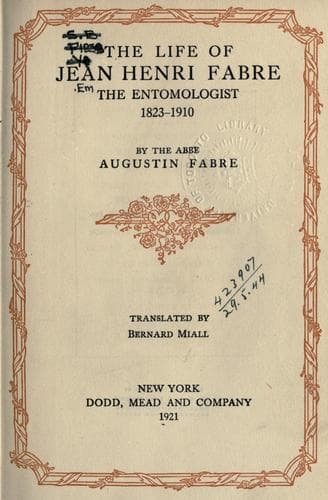
The life of Jean Henri Fabre, the entomologist, 1823-1910 — John Shaqi
The life of Jean Henri Fabre, the entomologist, 1823-1910Fabre, Augustin
Science
The life of Jean Henri Fabre, the entomologist, 1823-1910
Fabre, Augustin
Entomologists -- France -- Biography; Fabre, Jean-Henri, 1823-1915
This gloomy picture of a sudden, terrifying, violent death may be
compared with another which, in some respects, is even more tragic:
that of the ruined home and the shattered life of the little Rodez
schoolboy, who was to leave the town somewhat as he left the
slaughter-house, bewildered by the catastrophe of which he had just
been the witness and was soon to be the victim. At this point of his
narrative his eyes are dim with tears and his voice is choked by a
half-suppressed sob.
Then, suddenly, good-bye to my studies, good-bye to Tityrus and
Menalcas! Ill-luck is swooping down on us, relentlessly. Hunger
threatens us at home. And now, boy, put your trust in God; run
about and earn your penn’orth of potatoes as best you can. Life is
about to become a hideous inferno. Let us pass quickly over this
phase.
Amid that lamentable chaos my love for the insect ought to have
gone under. Not at all. It would have survived the raft of the
Medusa. I still remember a certain Pine Cockchafer met for the
first time. The plumes on her antennæ, her pretty pattern of white
spots on a dark-brown ground were as a ray of sunshine in the
gloomy wretchedness of the day. [28]
CHAPTER VI
THE PUPIL TEACHER: AVIGNON (1841–43)
The stroke of misfortune which suddenly interrupted Jean-Henri’s
studies at the Rodez lycée made him an exile from his father’s house
and banished him from his native countryside.
For the second time he was, as it were, dropped upon the road like
Perrault’s Tom Thumb. And the fairy-tale comes to life again in the
Odyssey of the poor boy who wandered at random, picking up his food at
hazard, facing misfortune with a stout heart, and smiling whenever he
could at the poem of Nature, who always had some fresh surprise in
store for him.
Who can fail to be moved by pity and admiration, beholding him set
forth upon the broad, white highroads, a wandering child, all but lost,
seeking his way, seeking his livelihood even, without other relief, in
his extremity of distress, and almost without other food than his love
of Nature and his passion for learning? See him, for example, on the
day when, between Beaucaire and Nîmes, he contrived to make his dinner
off a few bunches of grapes “plucked furtively at the edge of a field,
after exchanging the poor remnant of his last halfpence for a little
volume of Réboul’s poems; soothing his hunger by intoxicating himself
with the verses of the workman poet,” [29] whose inspiration was of so
noble and Christian a character.
The whole Fabre is in this trait of the needy, enraptured youth, who
thinks nothing of hardships or of money provided he can find the
wherewithal to assuage his thirst for knowledge and the ideal.
Public-domain text, read in full here on John Shaqi.
Reviews
Reviews
No reviews yet
Be the first to share your thoughts on this work.
Join the Discussion
Join the discussion
Sign in to leave a comment or review.
Sign InorCreate an account