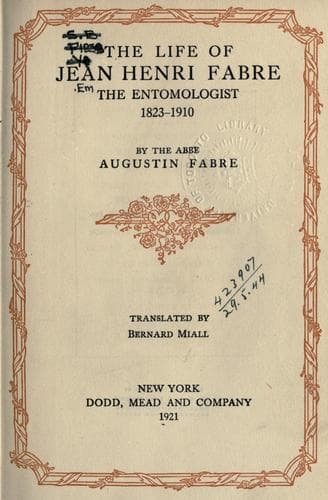
The life of Jean Henri Fabre, the entomologist, 1823-1910Fabre, Augustin
Science
The life of Jean Henri Fabre, the entomologist, 1823-1910
Fabre, Augustin
Entomologists -- France -- Biography; Fabre, Jean-Henri, 1823-1915
One might best compare the Ventoux with a heap of stones broken up
for road-mending purposes. Raise this heap suddenly to a height of
a mile and a quarter, increase its base in proportion, cover the
white of the limestone with the black stain of the forests, and you
have a clear idea of the general aspect of the mountain. This
accumulation of rubbish—sometimes small chips, sometimes huge
blocks—rises from the plain without preliminary slopes or
successive terraces that would render the ascent less arduous by
dividing it into stages. The climb begins at once by rocky paths,
the best of which is worse than the surface of a road newly strewn
with stones, and continues, becoming ever rougher and rougher,
right to the summit, the height of which is 6270 feet. Green
swards, babbling brooks, the spacious shade of venerable trees, all
the things, in short, that lend such charm to other mountains, are
here unknown and are replaced by an interminable bed of limestone
broken into scales, which slip under our feet with a sharp, almost
metallic “click.” By way of cascades the Ventoux has rills of
stones; the rattle of falling rocks takes the place of the
whispering waters. [59]
But the unsatisfied eagerness that draws the exile from our cool green
hills to repeat, again and again, the ascent of the rocky Provençal
height, is based on something more than sensitiveness to impressions
and a pre-established harmony; he is also strongly attracted by the
peculiar and unique variety of the flora growing upon its slopes:
Thanks to its isolated position, which leaves it freely exposed on
every side to atmospheric influences; thanks also to its height,
which makes it the topmost point of France within the frontiers of
either the Alps or the Pyrenees, our bare Provençal mountain, Mont
Ventoux, lends itself remarkably well to the study of the climatic
distribution of plants. At its base the tender olive thrives, with
all that multitude of semi-ligneous plants, such as the thyme,
whose aromatic fragrance calls for the sun of the Mediterranean
regions; on the summit, mantled with snow for at least half the
year, the ground is covered with a northern flora, borrowed to some
extent from Arctic shores. Half a day’s journey in an upward
direction brings before our eyes a succession of the chief
vegetable types which we should find in the course of a long voyage
from south to north along the same meridian. [60]
Public-domain text, read in full here on John Shaqi.
Reviews
Reviews
No reviews yet
Be the first to share your thoughts on this work.
Elsewhere in the archive
Join the Discussion
Join the discussion
Sign in to leave a comment or review.
Sign InorCreate an account