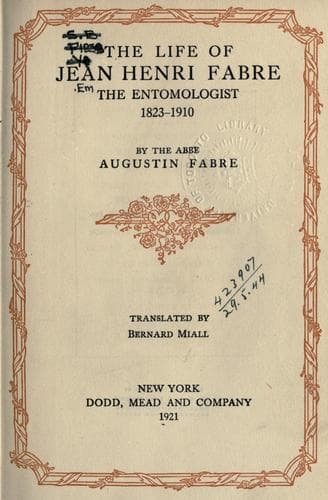
The life of Jean Henri Fabre, the entomologist, 1823-1910Fabre, Augustin
Science
The life of Jean Henri Fabre, the entomologist, 1823-1910
Fabre, Augustin
Entomologists -- France -- Biography; Fabre, Jean-Henri, 1823-1915
To any one with any love of plants, to any one with blood in his veins,
the expedition was a tempting one. So we see him set out for the
twenty-third time in company with two colleagues [61] and five others.
Let us join them if we wish to make the acquaintance of the botanist of
Mont Ventoux as well as the botany; for Fabre is one who throws himself
wholly into all that he does, and his history can no more be divorced
from that of his plants than from that of his beloved insects.
It is four o’clock in the morning. At the head of the caravan walks
Triboulet, with his Mule and his Ass: Triboulet, the Nestor of the
Ventoux guides. My botanical colleagues inspect the vegetation on
either side of the road by the cold light of the dawn; the others
talk. I follow the party with a barometer slung from my shoulder
and a note-book and pencil in my hand.
My barometer, intended for taking the altitude of the principal
botanical halts, soon becomes a pretext for attacks on the gourd
with the rum. No sooner is a noteworthy plant observed than
somebody cries:
“Quick, let’s look at the barometer!”
And we all crowd around the gourd, the scientific instrument coming
later. The coolness of the morning and our walk make us appreciate
these references to the barometer so thoroughly that the level of
the stimulant falls even more swiftly than that of the mercury. In
the interests of the immediate future I must consult Torricelli’s
tube a little less often.
As the temperature grows too cold for them, first the oak and the
ilex disappear by degrees; then the vine and the almond-tree; and
next the mulberry, the walnut-tree, and the white oak. Box becomes
plentiful. We enter upon a monotonous region extending from the end
of the cultivated fields to the lower boundary of the beech-woods,
where the predominant plant is Satureia montana, the winter savory,
known here by its popular name of pébré d’asé, Ass’s pepper,
because of the acrid flavour of its tiny leaves, impregnated with
essential oil. Certain small cheeses forming part of our stores are
powdered with this strong spice. Already more than one of us is
biting into them in imagination and casting hungry glances at the
provision bags carried by the Mule. Our hard morning exercise has
brought appetite, and more than appetite, a devouring hunger, what
Horace calls latrans stomachus. I teach my colleagues how to stay
this rumbling stomach until they reach the next halt; I show them a
little sorrel-plant, with arrow-head leaves, the Rumex scutatus, or
French sorrel; and, practising what I preach, I pick a mouthful. At
first they laugh at my suggestion. I let them laugh and soon see
them all occupied, each more eagerly than his fellow, in plucking
the precious sorrel.
Public-domain text, read in full here on John Shaqi.
Reviews
Reviews
No reviews yet
Be the first to share your thoughts on this work.
Elsewhere in the archive
Join the Discussion
Join the discussion
Sign in to leave a comment or review.
Sign InorCreate an account