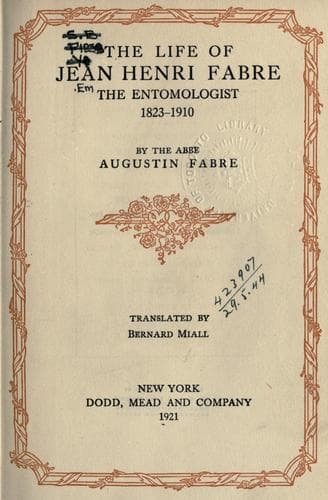
The life of Jean Henri Fabre, the entomologist, 1823-1910 — John Shaqi
The life of Jean Henri Fabre, the entomologist, 1823-1910Fabre, Augustin
Science
The life of Jean Henri Fabre, the entomologist, 1823-1910
Fabre, Augustin
Entomologists -- France -- Biography; Fabre, Jean-Henri, 1823-1915
The spot which was the scene of this first awakening deserves
description. When one follows the road from Laissac to Vezins, a short
distance after passing Vaysse-Rodié, just as one has almost reached the
crest of the height which by reason of its rocky helmet is called the
puech del Roucas, on the line of the watershed dividing the limestone
basin of the Aveyron from the granitic basin of the Viaur, on turning
sharply to the right one sees before one the austere Malavallis,
dominated on the one hand by the height of Lavaysse with its ancient
church, and enlivened a little on the other side by the tiny hamlet of
Malaval, which consists, to-day, of two farm-houses; one whiter, more
cheerful-looking, and on lower ground; the other standing higher,
greyer in hue, and more difficult to discover in the shade of the
oak-trees and thickets of broom and blackthorn which form a dense
mantle of green about it. It was there, amid these trees, in this
house, three thousand feet above the sea, in sight of the sturdy belfry
of Lavaysse, that Jean-Henri Fabre was “born into the true life,” the
life of the mind. Here, on this hillside, which directly faces the
east, he made his earliest discoveries; here, one fine morning, as he
will presently tell us, he discovered the sun; here, he saw not only
the dawn of day, but also “that inward dawn, so far swept clear of the
clouds of unconsciousness as to leave him a lasting memory.”
Nothing could take the place of the picturesqueness and sincerity of
the narrative in which he has related these earliest impressions of his
childhood:
My grandparents [12] were people whose quarrel with the alphabet was so
great that they had never opened a book in their lives; and they kept a
lean farm on the cold granite ridge of the Rouergue table-land. The
house, standing alone amidst the heath and broom, with no neighbour for
many a mile around and visited at intervals by the wolves, was to them
the hub of the universe. But for a few surrounding villages, whither
the calves were driven upon fair-days, the rest was only very vaguely
known by hearsay. In this wild solitude, the mossy fens, with their
quagmires oozing with iridescent pools, supplied the cows, the
principal source of wealth, with plentiful pasture. In summer, on the
short sward of the slopes, the sheep were penned day and night,
protected from beasts of prey by a fence of hurdles propped up with
pitchforks. When the grass was cropped close at one spot, the fold was
shifted elsewhither. In the centre was the shepherd’s rolling hut, a
straw cabin. Two watch-dogs, equipped with spiked collars, were
answerable for tranquillity if the thieving wolf appeared in the night
from out the neighbouring woods.
Public-domain text, read in full here on John Shaqi.
Reviews
Reviews
No reviews yet
Be the first to share your thoughts on this work.
Join the Discussion
Join the discussion
Sign in to leave a comment or review.
Sign InorCreate an account