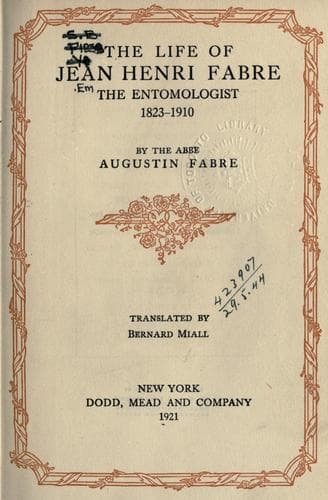
The life of Jean Henri Fabre, the entomologist, 1823-1910Fabre, Augustin
Science
The life of Jean Henri Fabre, the entomologist, 1823-1910
Fabre, Augustin
Entomologists -- France -- Biography; Fabre, Jean-Henri, 1823-1915
I don’t know what I replied; probably what he himself replied to
his illustrious master: Then there is a silk-worm disease? There
are provinces that are being ruined by it? All this was happening
so far from Paris, and we were so far from Paris in the
laboratory!...
Pasteur hesitated. He was not a physiologist. But Dumas’
insistence, the attraction of the unknown, and an inward voice
urged him to accept. So he left for the Midi; it was early in June
1865. He was invested with an official mission which confronted him
with a plague that had to be conquered and obliged him to render an
account of the attempts made and the results obtained.
To be sent to fight a fire and not to know what fire is and to have
no fire-engine or hose! It needed Pasteur to accept and to shoulder
such a responsibility!... To his complaint that he had no knowledge
of the matter, Dumas had replied:
“So much the better! You will have no ideas on the subject but
those that will come to you as a result of your own observations!”
This reply is not always a paradox, but one has to be careful to
whom one makes it! [70]
In this case the choice was not mistaken, and the lesson was as
profitable to Pasteur as it was to Fabre, to whom he was about to hand
it on, all unsuspecting.
When Pasteur was called upon to regenerate sericulture, the silk-worm
disease had been known for twenty years. During that period much
research had been undertaken and many efforts had been made, in France
as well as in Italy, to discover the nature of the affection and to
fight it. But “of all this story, a mixture of truth and falsehood,
Pasteur knew nothing when he began his researches.” More—and this was
what astonished Fabre—he knew nothing of the physiology or the rearing
of the silk-worm. “For the first time he has seen a cocoon, and has
learned that there is something in the cocoon, a rough model of the
future moth,” ... and he is about to revolutionise the hygiene of the
silk-worm nurseries and is preparing to revolutionise medicine and
general hygiene in the same way, [71] by showing that the maladies of
silk-worms and most of our human maladies arise from the development in
the tissues of a microscopic living entity, a microbe, the cause of the
malady. And while his other discoveries won for him only fame and the
admiration of his contemporaries, this will give him immortality and
place him in the front rank of the benefactors of humanity. Decidedly
ignorance may have its advantages.
Public-domain text, read in full here on John Shaqi.
Reviews
Reviews
No reviews yet
Be the first to share your thoughts on this work.
Elsewhere in the archive
Join the Discussion
Join the discussion
Sign in to leave a comment or review.
Sign InorCreate an account