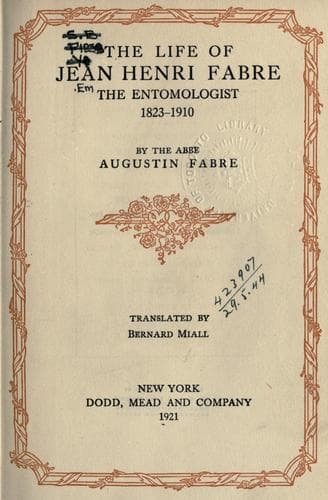
The life of Jean Henri Fabre, the entomologist, 1823-1910Fabre, Augustin
Science
The life of Jean Henri Fabre, the entomologist, 1823-1910
Fabre, Augustin
Entomologists -- France -- Biography; Fabre, Jean-Henri, 1823-1915
Encouraged by the magnificent example of Pasteur (continues the
entomologist), I have made it a rule to adopt the method of
ignorance in my investigations of the instincts. I read very
little. Instead of turning over the leaves of books, an expensive
method which is not within my means, instead of consulting others,
I set myself obstinately face to face with my subject until I
contrive to make it speak. I know nothing. So much the better; my
interrogation will be all the freer, to-day tending in one
direction, to-morrow in another, according to the information
acquired. And if by chance I do open a book, I am careful to leave
a section of my mind wide open to doubt. [72]
Beginning with that arising out of Dufour’s memoir, repeated
experiences taught Fabre not to be too greatly influenced, in his
conceptions of natural objects, by faith in his reading or even in the
assertions of his masters. To go still further, Pasteur’s example made
him appreciate the advantage of coming fresh to the facts, of
confronting them in a state of ignorance, of receiving impressions from
them alone, and of having no ideas but those that truly emanate from
the reality.
Without going to extremes, Fabre benefited by this twofold lesson. No
one had a greater respect for his masters; he quotes them readily and
is chary neither of praising their works nor of expressing his
gratitude to them; [73] but no one was ever more independent in his
researches and his conclusions, which are often the very contrary of
theirs. If he revered his masters he revered the truth still more, and
he might well have made his own the celebrated maxim: Amicus Plato,
magis amica veritas.
Let us add that while no one was ever more interested in authors and
their writings, to purchase which he often sacrificed his last coppers,
and even his daily bread, no one was more resolutely determined to give
the first place to the language of facts, and direct intercourse with
the tiny living creatures whom he had chosen for his own. So much so
that, if we wish fully to describe his method, we must complete the
maxim which we have just quoted by this other, which forms its exact
counterpart: Amicus liber, magis amica natura.
CHAPTER XII
THE PROFESSOR: AVIGNON (CONTINUED)
When Pasteur called upon Fabre, at the beginning of his investigation
of the silk-growing industry, he was also greatly interested in the
improvement of wines by the application of heat. [74] Thus it was that,
having obtained the needed information respecting the silk-worm from
the Avignon naturalist, he suddenly asked him to show him his cellar.
Fabre found the request extremely embarrassing:
Public-domain text, read in full here on John Shaqi.
Reviews
Reviews
No reviews yet
Be the first to share your thoughts on this work.
Elsewhere in the archive
Join the Discussion
Join the discussion
Sign in to leave a comment or review.
Sign InorCreate an account